If you’ve spent any time looking at anti-aging skincare, you’ve probably come across both retinol and retinal.
Their names differ by just two letters, they both belong to the vitamin A family, and both are used in products designed to improve the appearance of skin texture, uneven tone and signs of aging.
But they aren’t exactly the same.
The biggest difference comes down to what happens after you put them on your skin.
Affiliate Disclosure: This article may contain affiliate links. If you make a purchase through these links, Dew & Detail may earn a commission at no additional cost to you. Recommendations are based on product formulations and suitability, not affiliate availability.
Table of Contents
Retinol vs Retinal: The Quick Answer
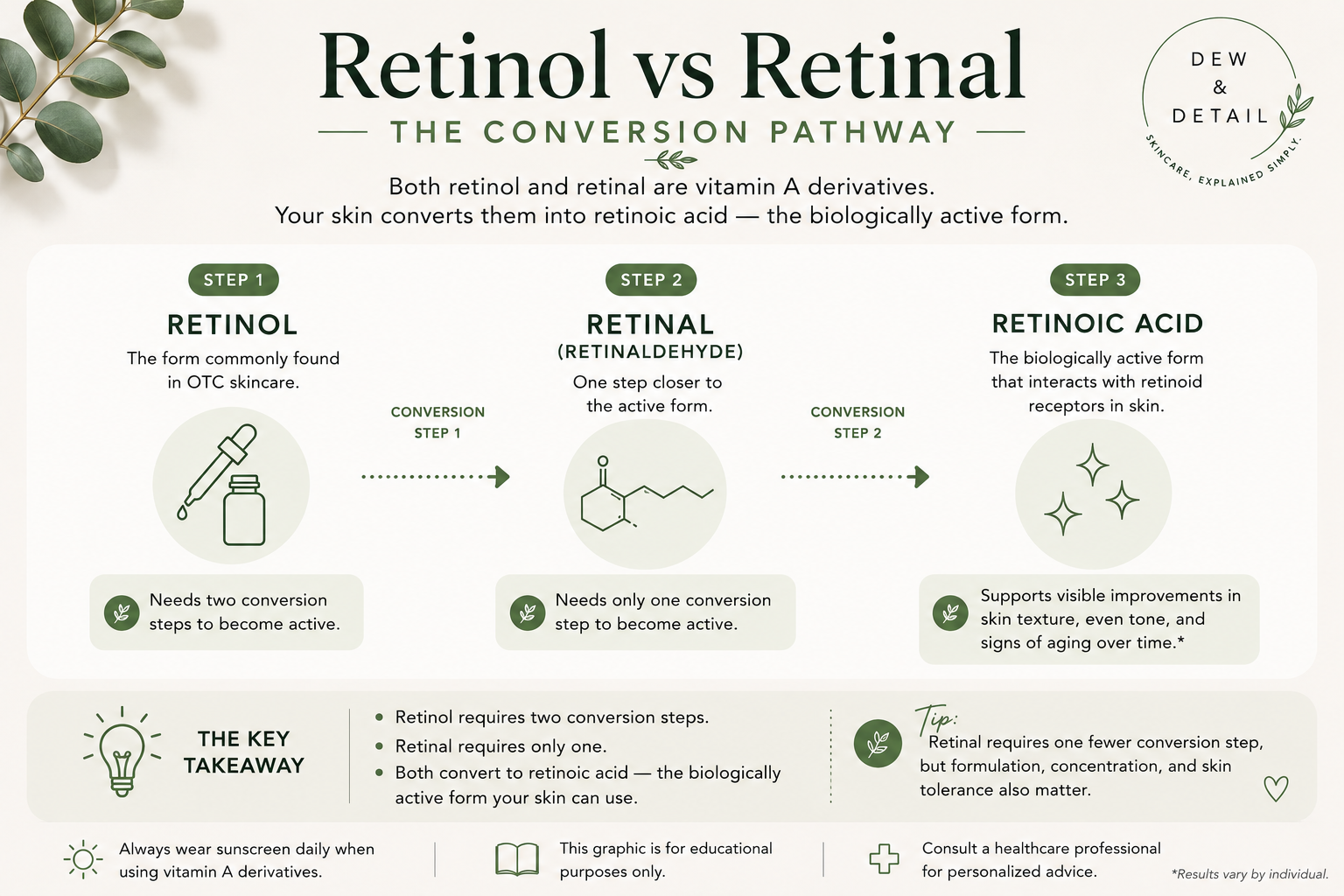
Both retinol and retinal (retinaldehyde) are vitamin A derivatives in the retinoid family. The key difference is how many conversion steps they require to reach retinoic acid, the biologically active form.
Retinol → Retinal → Retinoic Acid
Retinol requires two conversion steps, while retinal requires only one.
Because retinal sits one step closer to retinoic acid, it has a theoretical advantage. However, that doesn’t automatically make every retinal product better than every retinol product. Concentration, formulation, stability, frequency of use and your skin’s tolerance all matter.
Retinol vs Retinal at a Glance
| Feature | Retinol | Retinal |
|---|---|---|
| Also called | Retinol | Retinaldehyde |
| Vitamin A derivative | Yes | Yes |
| Steps to retinoic acid | 2 | 1 |
| Availability in OTC skincare | Very common | Increasingly common |
| Used for signs of aging | Yes | Yes |
| Can cause irritation | Yes | Yes |
| Good for beginners? | Often | Potentially, depending on formulation |
| Prescription required? | No | No |
So which one deserves a place in your routine?
That depends on what your skin needs.
What Is Retinol?
Retinol is probably the most familiar cosmetic retinoid.
It’s widely available in over-the-counter serums, creams and treatments designed to address concerns including uneven texture, pigmentation and visible signs of aging.
The American Academy of Dermatology describes retinol as a type of retinoid used for concerns such as uneven skin tone, pigmentation and texture. Retinoids as a broader group can also help with fine lines and acne.
Retinol isn’t retinoic acid itself, which is why OTC retinol shouldn’t be treated as equivalent to prescription tretinoin.
What Is Retinal?
Retinal is short for retinaldehyde.
It also belongs to the vitamin A family, but it sits one stage further along the conversion pathway:
Retinal → Retinoic Acid
So while retinol has to undergo two conversions, retinal has only one remaining.
Clinical literature describes retinaldehyde as a precursor to retinoic acid and notes its useful balance between topical activity and tolerability.
This distinction has made retinal increasingly interesting in cosmetic skincare.
But there’s an important caveat.
One fewer conversion doesn’t tell us everything.
It’s tempting to conclude:
Retinal is closer to retinoic acid, therefore every retinal product must be dramatically stronger and faster.
Skincare isn’t quite that simple.
The finished formula matters enormously.
Two products can contain different concentrations, delivery systems, supporting ingredients and formulations. How consistently you use the product—and how well your skin tolerates it—can matter just as much.
So instead of asking only “Which ingredient is stronger?”, a better question is:
“Which formulation can I use consistently without overwhelming my skin?”
Retinal vs Retinol: Which Works Faster?
This is one of the most common questions—and one where skincare marketing can oversimplify the science.
Retinal has a shorter metabolic pathway to retinoic acid than retinol. That provides a reasonable biological basis for expecting potent activity from well-formulated retinal products.
But statements such as:
“Retinal works exactly 10 or 11 times faster than retinol”
shouldn’t automatically be treated as universal facts.
Different concentrations and formulations aren’t interchangeable, and there isn’t a simple conversion calculator that tells you exactly how one commercial retinal product compares with another retinol product.
At Dew & Detail, our rule is simple:
Don’t choose a retinoid because the biggest number or strongest marketing claim sounds impressive. Choose something your skin can tolerate consistently.
Which Is Better for Fine Lines and Signs of Aging?
Both can have a place in an anti-aging skincare routine.
Retinoids are among the best-established topical ingredient families used for concerns such as fine lines, uneven pigmentation and texture. The AAD notes that retinoids can promote surface skin-cell turnover and collagen production, improving tone and reducing fine lines and wrinkles.
So the decision doesn’t necessarily need to be:
“Which is the strongest?”
Instead, consider:
Are you completely new to retinoids?
A lower-strength retinol product can be a sensible starting point, although the formulation and your skin’s tolerance matter too.
Already comfortable using retinol?
A retinal product may be an interesting next option.
Very reactive or dry skin?
Don’t assume either ingredient will automatically be gentle. Formula and concentration matter, and the AAD notes that people with significant dryness, allergies, redness or inflammation may not be good candidates for retinoids without professional guidance.
And remember: retinoids aren’t the entire anti-aging routine.
Daily sun protection is fundamental. Dermatologists recommend broad-spectrum SPF 30 or higher to help prevent premature skin aging.
For a broader look at collagen, elastin, sun exposure and the other factors that influence how skin changes with age, see our guide: Skin Firmness After 30.
Retinol vs Retinal for Acne
Here’s where we need to make an important distinction.
Certain topical retinoids are well established in acne treatment, but OTC cosmetic retinol or retinal shouldn’t automatically be equated with prescription acne medication.
Dermatologists use specific topical retinoids such as adapalene, tretinoin, tazarotene and trifarotene for acne. Adapalene is also available over the counter in some markets.
Retinaldehyde has also been used in cosmetic preparations for acne-prone skin, but someone dealing with persistent, moderate or severe acne shouldn’t simply choose a more potent-sounding cosmetic retinal serum instead of seeking appropriate acne treatment.
Dew & Detail takeaway: If your main goal is treating significant acne rather than cosmetic texture or signs of aging, a dermatologist can help you choose an evidence-based acne treatment rather than relying solely on cosmetic retinoids.
Which Is Better for Beginners?
For many beginners, retinol can be a sensible starting point because there are numerous formulations and concentrations available.
But retinal isn’t automatically unsuitable for beginners.
A thoughtfully formulated lower-strength retinal product may be tolerable for some first-time users.
What’s more important is how you introduce it.
The AAD recommends starting with a lower-strength retinoid and initially using it every other night rather than jumping straight into aggressive daily application.
And don’t introduce several strong actives simultaneously.
If your skin suddenly becomes irritated, you won’t even know which product caused it.
What About Sensitive Skin?
Sensitive skin doesn’t necessarily mean you can never use a retinoid.
But caution matters.
Retinoids can cause:
- dryness
- redness
- peeling
- stinging
- irritation
The AAD notes that irritation doesn’t necessarily mean a true allergy. Using a smaller amount, reducing frequency or incorporating moisturizer may help in appropriate cases.
If your skin already has substantial redness, inflammation or severe dryness, however, getting professional advice before adding a retinoid is sensible.
How to Start Using Retinol or Retinal
You don’t need a complicated 10-step routine.
1. Gentle cleanser
Wash your skin without aggressive scrubbing. Choose a gentle cleanser that suits your skin type and leaves your skin comfortable rather than tight or stripped.
2. Retinol OR retinal
Choose one retinoid rather than using retinol and retinal together in an attempt to get faster results.
Follow the amount and frequency specified for your particular product.
3. Moisturizer
A well-chosen moisturizer can help support skin comfort and reduce the dryness that may occur when starting a retinoid.
The AAD also notes that moisturizer can sometimes be used before a retinoid when dryness is an issue.
Start slowly.
More product doesn’t equal faster progress.
Overdoing active skincare can simply create irritation. Dermatologists similarly recommend starting one anti-aging product at a time rather than introducing several simultaneously.
Retinol & Retinal Strengths: Where Should You Start?
| Experience level | Retinol approach | Retinal approach |
|---|---|---|
| New to retinoids | Lower-strength/gentler formulation | Lower-strength retinal formulation |
| Some retinoid experience | Moderate-strength option | Beginner/intermediate retinal |
| Experienced user | Higher-strength option if tolerated | Progressive retinal strengths |
Can You Use Retinol and Retinal Together?
For most people, there’s little reason to layer a retinol product and retinal product in the same routine.
They belong to the same retinoid pathway.
Using both isn’t an automatic shortcut to better results and could increase irritation.
Choose one, introduce it carefully, and judge your skin’s response over time.
What Should You Avoid Using With Retinol or Retinal?
You’ve probably seen graphics telling you:
“NEVER MIX THESE INGREDIENTS!”
The reality is more nuanced.
Some combinations aren’t inherently forbidden, but layering several potentially irritating actives at once can make a routine difficult to tolerate.
When you’re first introducing a retinoid, be particularly cautious about using strong exfoliating acids or other potentially irritating treatments at the same time.
Rather than memorizing a huge list of forbidden combinations, use a simpler principle:
Introduce one strong active at a time and watch how your skin responds.
For a closer look at which combinations may increase irritation—and which pairings are often misunderstood—see our guide: Skincare Ingredients You Shouldn’t Mix
If you’re using prescription acne treatments or other dermatologic medications, ask your dermatologist how to combine them rather than relying on generic skincare rules.
Do You Need Sunscreen When Using Retinol or Retinal?
Yes.
Sun protection should already be part of a good skincare routine, and it becomes especially important when you’re investing effort into improving pigmentation and visible signs of aging.
The AAD recommends using retinoids at night and protecting the skin from the sun during the day. For sunscreen, look for:
Broad-spectrum protection + SPF 30 or higher + water resistance.
Think of sunscreen and your retinoid as complementary parts of a long-term skincare routine.
Retinol vs Retinal During Pregnancy
This section is important enough not to hide in the FAQs.
Avoid retinoids during pregnancy.
The American Academy of Dermatology specifically advises avoiding both prescription retinoids and over-the-counter retinol-containing skincare during pregnancy.
If you’re pregnant, trying to become pregnant, or unsure about a product, discuss your skincare with your obstetrician or dermatologist.
Retinol & Retinal Product Picks
Choosing between retinol and retinal isn’t only about picking the strongest percentage. The formulation, delivery system, supporting ingredients, product texture and your previous experience with retinoids can all affect how well a product fits your routine.
The products below cover different strengths, formats and skin needs, from lower-strength formulas for newer retinoid users to more advanced options.
Retinol Face Products
Retinol is available in everything from lightweight serums and ampoules to creams, oils and moisturizers. If you’re new to retinoids, starting with a lower-strength or tolerability-focused formula may make it easier to introduce retinol gradually.
| Product | Strength | Why We Recommend It | Best For |
|---|---|---|---|
| Innisfree Retinol Cica Repair Ampoule | 0.015% retinol | Very gentle retinol ampoule combining low-strength retinol with soothing and barrier-supportive ingredients, making it an approachable introduction to retinoids. | Sensitive skin / very gentle beginners |
| COSRX The Retinol 0.1 Cream | 0.1% retinol | Clearly disclosed low-strength retinol cream designed for beginners wanting to address early fine lines, texture and uneven-looking skin. | Beginner retinol users |
| Anua Retinol 0.3% + Niacin Renewing Serum | 0.3% retinol | Intermediate-strength K-beauty serum combining retinol with niacinamide and moisturizing, soothing and barrier-supporting ingredients. | Intermediate users / texture & uneven tone |
| CeraVe Resurfacing Retinol Serum | Encapsulated Retinol | Fragrance-free retinol serum with niacinamide and ceramides, specifically suited to improving the appearance of post-acne marks, uneven texture and visible pores. | Post-acne marks, pores & texture |
| Kiehl’s Retinol Skin-Renewing Daily Micro-Dose Serum | Micro-Dose Retinol | Daily retinol serum combining retinol with ceramides and peptide support for readers who prefer a gentler, gradual approach to visible signs of aging. | Sensitive skin / regular-use anti-aging |
| Medik8 Intelligent Retinol | 0.3%, 0.6% & 1% retinol | Progressive retinol system available in multiple clearly disclosed strengths, allowing experienced users to gradually move to higher concentrations as tolerated. | Progressive-strength retinol users |
| Paula’s Choice CLINICAL 1% Retinol Face Treatment | 1% retinol | High-strength retinol treatment for experienced users looking to target more established concerns such as fine lines, uneven tone and texture. | Experienced/advanced retinol users |
Retinol Eye Treatments
Retinol can also be formulated specifically for the eye area. Eye treatments generally use formulations designed for the thinner skin around the eyes, so a facial retinol product shouldn’t automatically be used around the eyes unless its directions say it can be.
| Product | Strength | Why We Recommend It | Best For |
|---|---|---|---|
| Medik8 Intelligent Retinol Eye TR | 0.1% Retinol | Dedicated fragrance- and alcohol-free eye serum with 0.1% retinol, vitamin E and climbazole, designed to provide gradual vitamin A care around the delicate eye area. | Fine lines / gradual retinol use |
| Anua Retinol 0.1 Caffeine Revitalizing Eye Cream | 0.1% Retinol | Combines retinol with caffeine, niacinamide, ceramides, peptides and hyaluronic acid to target fine lines while also addressing tired-looking under-eyes. | Fine lines + dark circles/puffiness |
| RoC Retinol Correxion Line Smoothing Eye Cream | Retinol; % not disclosed | Dedicated retinol eye cream formulated to address fine lines, crow’s feet, dark circles and puffiness while remaining suitable for regular eye-area use. | Crow’s feet + multiple aging concerns |
Retinal Face Products
Retinal, also called retinaldehyde, is one conversion step away from retinoic acid. Today, retinal is available in far more than traditional serums, including emulsions, creams, boosters and richer nighttime treatments.
| Product | Strength | Why We Recommend It | Best For |
|---|---|---|---|
| Medik8 Crystal Retinal | 0.01%–0.24% Retinal | A progressive retinal system with multiple strengths, making it easy to gradually increase retinal intensity as skin tolerance develops. | Progressive retinal users / beginner to advanced |
| Geek & Gorgeous A-Game 5 Retinal Serum | 0.05%, 0.1% & 0.2% Retinal | Offers clearly disclosed retinal strengths at an accessible price, allowing users to progress from moderate to high-strength retinal. | Best value / progressive retinal use |
| Naturium Retinaldehyde Cream Serum | 0.05%, 0.10% & 0.15% Retinaldehyde | A fragrance-free cream-serum range that combines retinaldehyde with a comfortable, barrier-conscious formula. | Dry, sensitive or gradual retinal users |
| The Ordinary Retinal 0.2% Emulsion | 0.2% Retinal | A straightforward, high-strength retinal formula with a clearly disclosed concentration at an accessible price. | Experienced retinal users / high-strength option |
| Peach & Lily Retinal For All Renewing Serum | 0.1% Encapsulated Retinal | Combines encapsulated retinal with ectoin and ceramides for a more barrier-supportive approach to retinal. | Retinal + barrier support |
| Celimax The Vita-A Retinal Shot Tightening Booster | 0.1% Retinal | Combines retinal with niacinamide, panthenol and peptides in a Korean formula designed to target visible texture, pores and firmness. | Pores, texture & firmness |
| K-SECRET SEOUL1988 Retinal Serum for Fine Lines & Pore Care | Retinal Liposome 2% complex* | Combines a retinal liposome system with black ginseng in a lightweight K-beauty serum. | K-beauty retinal users / uneven texture |
| Allies of Skin Retinal & Peptides Repair Night Cream | 0.05% or 0.1% Encapsulated Retinal | Combines encapsulated retinal with peptides and barrier-supportive ingredients in a nourishing night-cream format. | Dry/dehydrated skin / retinal night cream |
Important: A percentage referring to a retinal complex, liposome or delivery system is not necessarily the percentage of pure retinal in the finished product. For example, K-SECRET’s “2% Retinal Liposome” should not be interpreted as 2% pure retinal or directly compared with products that disclose 0.1% or 0.2% retinal.
Retinal Eye Treatments
Retinal is increasingly appearing in dedicated eye treatments. As with facial retinal products, the percentage on the packaging doesn’t always represent the concentration of pure retinal, so different products shouldn’t be compared by numbers alone.
| Product | Retinoid / Strength | Why We Recommend It | Best For |
|---|---|---|---|
| Medik8 Crystal Retinal Ceramide Eye | 0.03%, 0.06% or 0.1% Retinal | Offers three progressive retinal strengths with twin-encapsulated retinal, ceramides and hydrating ingredients for gradually increasing retinal use around the eyes. | Progressive retinal use / fine lines & wrinkles |
| Beauty of Joseon Revive Eye Serum | 0.02% Retinal (from 2% Retinal Liposome) | Combines a gentle retinal concentration with ginseng, niacinamide and barrier-supportive ingredients in a lightweight K-beauty eye serum. | Beginners / gentle K-beauty retinal |
| Avène Retrinal EYES Advanced 3-in-1 Eye Cream | Retinaldehyde — % not disclosed | Combines retinaldehyde with hyaluronic acid and dextran sulfate in a fragrance-free formula designed to address visible wrinkles, puffiness and dark circles. | Sensitive skin / dark circles + puffiness + fine lines |
| K-SECRET Seoul 1988 Eye Cream | Retinal Liposome 4% complex* | Combines a retinal liposome system with fermented ingredients, niacinamide, bakuchiol and peptides for a multi-targeted K-beauty eye treatment. | Wrinkles + uneven tone / K-beauty retinal |
A Note About Retinoid Percentages
Retinoid percentages are not always directly comparable between products.
Some brands disclose the concentration of pure retinol or retinaldehyde in the finished formula. Others disclose the concentration of an encapsulated, liposomal or proprietary retinoid complex.
For example, a product described as containing a 2% retinal liposome complex should not be interpreted as containing 2% pure retinal, and a 4% retinal liposome complex should not automatically be considered stronger than a product containing 0.1% pure retinaldehyde.
The delivery system, overall formulation, supporting ingredients and your ability to use the product consistently can also influence how a retinoid product performs and how well it is tolerated.
How to Choose From These Products
If you’re completely new to retinoids, you don’t need to start with the strongest formula available. A lower-strength retinol or retinal product can give your skin time to adjust.
If you already tolerate retinol well but want to explore retinal, consider starting with an appropriate retinal strength rather than automatically choosing the highest concentration.
More experienced users may prefer products with clearly defined progressive strengths, which allow you to move up gradually instead of making a large jump.
Whatever you choose, introduce one retinoid product at a time. Avoid layering multiple retinol and retinal treatments in the same routine simply because they appear in different product categories.
Use moisturizer as needed, follow the individual product’s directions and wear broad-spectrum sunscreen during the day.
Retinol vs Retinal: Frequently Asked Questions
Is retinal stronger than retinol?
Retinal is generally considered more potent than retinol because it sits one conversion step closer to retinoic acid. However, you can’t determine the performance of a finished product from the ingredient name alone. Concentration and formulation matter.
Is retinal the same as tretinoin?
No.
Retinal must still be converted into retinoic acid. Tretinoin is retinoic acid and is a prescription medication in many countries.
Can beginners use retinal?
Potentially. Being a beginner doesn’t automatically rule out retinal, but starting with an appropriate formulation and introducing it gradually is important.
Can I switch from retinol to retinal?
Yes, people who already tolerate retinol may choose to explore retinal. Don’t assume you need to use the same concentration or immediately use retinal every night, though.
Can I use retinal every night?
Some people eventually tolerate frequent use, but frequency should follow the particular product’s directions and your skin’s response. Starting gradually is generally more sensible than immediately maximizing frequency.
How long before I see results?
Don’t judge a retinoid after a few nights. Results take time, and the timeline can vary depending on the product, concentration, concern and consistency of use. The AAD notes that many anti-aging products need at least six weeks to show improvement, and sometimes around three months.
Is peeling a sign that retinal is working?
No. More irritation doesn’t mean better results. Excessive dryness, burning or irritation is a reason to reconsider how you’re using the product rather than treating discomfort as proof of effectiveness.
The Dew & Detail Takeaway
Retinol and retinal belong to the same vitamin A family, but they’re separated by one important step:
Retinol → Retinal → Retinoic Acid
Retinol has two conversions to reach retinoic acid, while retinal has one.
That makes their chemistry different—but skincare decisions shouldn’t be based on conversion steps alone.
Your skin type, the formulation, concentration, tolerance and consistency all matter.
If you’re starting out, there’s nothing wrong with choosing a gentle retinol.
If you’re already comfortable with retinoids, retinal may be worth exploring as another option.
And whichever you choose, slow and consistent beats strong and irritated.
Sources & Further Reading
- American Academy of Dermatology Association — Retinoid or retinol?
- Kwon HS et al. — Retinaldehyde for Photoaged Skin: Randomized Controlled Trial — PubMed
- Mambwe B et al. — Cosmetic Retinoid Use in Photoaged Skin: A Review — PubMed
Medical disclaimer
This article is for general educational purposes and is not a substitute for medical advice, diagnosis or treatment. If you have a skin condition, use prescription medication, are pregnant or are trying to conceive, consult an appropriate healthcare professional about your skincare routine.