Walk into any skincare aisle and choosing a moisturizer suddenly feels more complicated than it should.
There are lightweight gels, bouncy gel-creams, lotions, rich creams, barrier creams and thick balms. Then there are ingredient claims: hyaluronic acid for hydration, ceramides for the skin barrier, niacinamide for brightening, peptides for aging skin—the list keeps growing.
But the richest moisturizer isn’t automatically the best one. And choosing between a gel and a cream based only on whether your skin is “oily” or “dry” tells only part of the story.
The right moisturizer depends on your skin type, how much richness your skin needs, your main skin concerns, the rest of your skincare routine and how your skin actually responds to the formula.
This guide breaks down the different types of moisturizers, how they work and how to choose one without getting lost in skincare marketing.
Types of Moisturizers: The Quick Answer
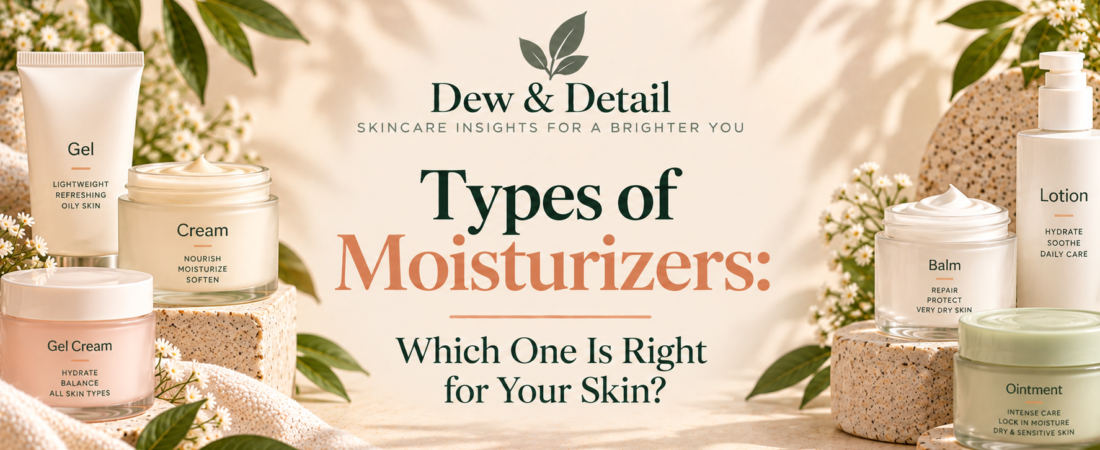
Moisturizers generally come in textures such as gels, gel-creams, lotions, creams and ointments or balms.
As a general rule:
- Gels are lightweight and may appeal to oily skin or feel more comfortable in humid-weather.
- Gel-creams provide a middle ground between a gel and a cream.
- Lotions are fluid, spread easily and provide moderate moisturization.
- Creams are richer and often better suited to dry skin or situations where more emollience or occlusion is useful.
- Ointments and balms are usually the most occlusive and can be useful for very dry or compromised areas.
But texture is only the beginning.
Most moisturizers work through some combination of humectants, emollients and occlusives. The best choice is therefore not simply “gel for oily skin” or “cream for dry skin.”
Think of moisturizer selection as:
Skin type → Texture → Skin concern → Functional ingredients → Rest of your routine → Personal tolerance
Table of Contents
What Does a Moisturizer Actually Do?
The outermost layer of your skin—the stratum corneum—plays a major role in keeping water in your skin while limiting excessive water loss to the environment.
A moisturizer can help by:
- increasing water content in the outer skin
- reducing excessive water loss
- softening rough or flaky skin
- smoothing the skin surface
- supporting normal barrier function
- improving the temporary appearance of dryness-related fine lines
Moisturizers do not all achieve this in exactly the same way. Their effect depends on the overall formulation, including the ingredients used and the balance of hydration, emollience and occlusion.
Not everyone needs the same amount—or even the same number of moisturizing steps. Your cleanser, treatments, sunscreen, environment and individual skin all influence how much additional moisturization you need.
Hydration vs Moisturization: Are They the Same?
The words are often used interchangeably, but there is a useful distinction.
Hydration refers primarily to water content in the outer skin.
Moisturization is broader. A moisturizer may help increase or retain water, soften the skin and reduce water loss.
This is why applying a hydrating serum does not necessarily produce the same effect as applying a complete moisturizer.
How Moisturizers Work: Humectants, Emollients & Occlusives
You will often see humectants, emollients and occlusives described as “types of moisturizers.”
Technically, it is more useful to think of them as functional components within moisturizer formulations.
A single moisturizer may contain all three.
Humectants
Humectants help attract and retain water in the stratum corneum.
Common examples include:
- Glycerin
- Hyaluronic acid
- Urea
- Panthenol
- Sodium PCA
- Lactic acid
Humectants can be especially useful when skin feels dehydrated, tight or temporarily less plump.
But a moisturizer containing a humectant is not necessarily lightweight. A rich cream can contain plenty of glycerin, just as a gel can.
Emollients
Emollients primarily help make the skin feel softer and smoother by filling in surface irregularities between skin cells.
Examples can include:
- Squalane
- Fatty alcohols
- Oils
- Esters
- Certain silicones and lipids
They are particularly useful when skin feels rough rather than simply thirsty.
Occlusives
Occlusives form a water-resistant layer that helps reduce evaporation from the skin.
Examples include:
- Petrolatum
- Mineral oil
- Dimethicone
- Paraffin
- Waxes
Occlusion becomes particularly useful when skin is very dry or when preventing water loss is a priority.
Most Moisturizers Don’t Fit Into Just One Category
These categories overlap.
A well-designed formula often combines water-attracting ingredients with skin-softening ingredients and something that slows water loss.
So instead of asking:
“Is this a humectant moisturizer or an occlusive moisturizer?”
A better question is:
“What balance of hydration, emollience and occlusion does my skin need?”
This is also why a hydrating face serum and a moisturizer are not necessarily interchangeable—they may play different roles in your routine.
Types of Moisturizers by Texture
Now we can look at the categories you actually see while shopping.
Gel Moisturizers
Gel moisturizers tend to feel light, fresh and fast-absorbing.
They often appeal to:
- oily skin
- combination skin
- people who dislike rich creams
- hot or humid climates
- layering underneath sunscreen or makeup
However, a gel is not automatically better for acne-prone skin, and some dry or dehydrated skin types may find a very lightweight gel insufficient.
Gel-Cream Moisturizers
Gel-creams sit somewhere between a traditional gel and cream.
They can provide more cushioning than a watery gel without feeling as rich as a traditional cream.
They may be particularly useful for:
- combination skin
- dehydrated but oily skin
- normal skin
- people who want hydration without a heavy finish
For many people, this is one of the most versatile moisturizer textures.
Lotion Moisturizers
Lotions generally have a more fluid consistency than creams and spread easily over the skin.
They can work well for:
- normal skin
- combination skin
- mild dryness
- daytime use
- warmer weather
They are also convenient when moisturizing larger areas of the body.
Cream Moisturizers
Creams generally provide a richer feel than gels or lotions and often contain a greater proportion of emollient and occlusive components.
They often suit:
- dry skin
- mature skin that has become drier
- colder or drier environments
- routines containing potentially drying actives
- people who prefer a more cushioned finish
But cream does not automatically mean pore-clogging, just as gel does not guarantee that a product will suit acne-prone skin.
Balm and Ointment Moisturizers
Ointments and balm-like products sit at the richest end of the spectrum.
They can be useful for:
- extremely dry areas
- flaky patches
- lips
- areas needing strong occlusion
- certain compromised-barrier situations
Petrolatum-based ointments are particularly effective at reducing evaporative water loss, although their heavier feel is not necessary or enjoyable for everyone.
Does a Thicker Moisturizer Mean a Better Moisturizer?
No.
Richer means richer—not automatically better.
A thick cream may be exactly what severely dry skin needs but uncomfortable for someone living in humid weather with oily skin.
Likewise, a lightweight gel may feel perfect on oily skin but leave very dry skin feeling tight again soon after application.
The goal is not to find the richest formula you can tolerate.
It is to find enough moisturization for your skin without unnecessary heaviness or irritation.
How to Choose a Moisturizer for Your Skin Type
Skin type is a useful starting point—but not the entire decision.
Best Moisturizer for Oily Skin
Oily skin usually produces more sebum, but oil and water are not the same thing.
Someone can have oily skin and still experience dehydration, tightness or irritation.
A lightweight gel, gel-cream or lotion may be a comfortable starting point.
Look for a formula that provides adequate hydration without leaving a finish you find excessively greasy or heavy.
And do not assume every ingredient called an “oil” is automatically inappropriate. Finished formulation matters more than judging one ingredient in isolation.
Our Top Moisturizer Picks for Oily Skin
| Product | Why We Recommend It | Best For |
|---|---|---|
| Anua Barrier Reboot Water Gel Cream | Lightweight, non-sticky gel-cream with ceramide NP, cholesterol, panthenol, beta-glucan and squalane; non-comedogenic and fragrance-free. | Oily / sensitive skin + barrier support |
| Beauty of Joseon Red Bean Water Gel | Exceptionally lightweight, non-greasy gel created specifically with oily and combination skin in mind. | Very oily skin / humid climates |
| AESTURA ATOBARRIER365 Hydro Soothing Cream (New) | Lightweight ceramide-focused cream that provides stronger hydration and barrier support without a greasy finish. | Oily-dehydrated / sensitive skin |
| Dr.G R.E.D Blemish Clear Soothing Cream | Lightweight soothing moisturizer that provides a calming-focused alternative to oil-control treatments. | Oily-sensitive / breakout-prone skin |
| La Roche-Posay Effaclar Supramolecular Oil & Pores Correct Mattifying Moisturizer | Mattifying gel moisturizer combining salicylic acid and niacinamide, specifically designed for excess shine and visible pores. | Oily skin + shine / visible pores |
| Clinique Dramatically Different Moisturizing Gel | Straightforward oil-free, fragrance-free gel that provides lightweight hydration without adding a rich finish. | Best Western classic |
Best Moisturizer for Dry Skin
Dry skin often benefits from a more complete combination of:
Humectants + emollients + occlusives
A cream is often more satisfying than a lightweight gel, particularly when dryness includes flaking, roughness or tightness.
Useful ingredients may include glycerin, urea, emollient lipids, petrolatum, dimethicone, ceramides and other barrier-supportive ingredients depending on the formula.
Our Top Moisturizer Picks for Dry Skin
| Product | Why We Recommend It | Best For |
|---|---|---|
| AESTURA ATOBARRIER365 Cream | Rich facial cream combining humectants, emollients and barrier lipids including glycerin, squalane, ceramide NP and cholesterol. | Dry skin + barrier support |
| CeraVe Moisturizing Cream | Rich ceramide moisturizer that provides substantial moisturization in a widely available, relatively affordable formula. | Best budget / value |
| ILLIYOON Ceramide Ato Concentrate Cream | Rich ceramide-focused K-beauty moisturizer available in a generous size, making it particularly practical for frequent use on dry skin. | Best K-beauty value |
| Vanicream Moisturizing Cream | Substantial, straightforward moisturizer particularly useful when very dry skin also prefers a simpler formula. | Very dry + sensitive skin |
| La Roche-Posay Lipikar AP+M Triple Repair Moisturizing Cream | Rich, intensive moisturizer better suited to pronounced dryness and roughness than someone simply wanting light facial hydration. | Very dry / rough skin |
| Kiehl’s Ultra Facial Cream with Squalane | Long-lasting facial moisturizer with a lightweight, non-greasy cream texture for dry skin that doesn’t need an especially heavy balm. | Everyday dry skin / lighter cream preference |
Best Moisturizer for Combination Skin
Combination skin does not always fit neatly into one jar.
You have several options:
- Choose a medium-weight gel-cream or lotion
- Apply less moisturizer to oilier areas and more to dry areas
- Use different formulas on different areas if your skin genuinely needs them
There is no rule saying your entire face must receive exactly the same amount of moisturizer.
Our Top Moisturizer Picks for Combination Skin
| Product | Why We Recommend It | Best For |
|---|---|---|
| AESTURA ATOBARRIER365 Hydro Soothing Cream (New) | Lightweight ceramide-focused cream designed to balance hydration and oil without a heavy or greasy finish. | Combination-dehydrated / barrier support |
| La Roche-Posay Toleriane Double Repair Face Moisturizer | Lightweight cream with glycerin, squalane, niacinamide and ceramide NP that provides balanced everyday moisturization. | Combination-normal / balanced skin |
| Beauty of Joseon Red Bean Water Gel | Very lightweight, non-greasy gel specifically developed with oily and combination skin and oil-moisture balance in mind. | Combination-oily / humid climates |
| Torriden DIVE-IN Soothing Cream | Lightweight hydration-focused cream with multiple forms of hyaluronic acid plus panthenol and allantoin. | Combination-dehydrated skin |
| Vanicream Daily Facial Moisturizer | Straightforward lightweight facial moisturizer that provides hydration and barrier-supportive ingredients without requiring a rich cream. | Combination-sensitive skin |
Best Moisturizer for Normal Skin
Normal skin generally does not need an extremely lightweight or extremely rich moisturizer.
A lotion, gel-cream or comfortable cream may all work depending on your climate, routine and personal preference.
Rather than trying to “fix” normal skin, focus on maintaining comfortable hydration and choosing a texture you enjoy using consistently.
If your skin becomes temporarily drier because of weather, cleansing or active ingredients, you can simply move to a richer formula when needed.
Our Top Moisturizer Picks for Normal Skin
| Product | Why We Recommend It | Best For |
|---|---|---|
| La Roche-Posay Toleriane Double Repair Face Moisturizer | Balanced lightweight cream with glycerin, squalane, niacinamide and ceramide NP for comfortable everyday hydration without unnecessary richness. | Balanced everyday hydration |
| Beauty of Joseon Dynasty Cream | Nourishing moisturizer that provides comfortable hydration with a dewy finish without being an especially heavy barrier cream. | Hydration + dewy glow |
| Kiehl’s Ultra Facial Cream with 4.5% Squalane | Lightweight, non-greasy cream that provides longer-lasting moisturization when normal skin prefers something more nourishing. | Normal skin leaning dry |
| CeraVe PM Facial Moisturizing Lotion | Accessible lightweight lotion with ceramides, hyaluronic acid and niacinamide for straightforward everyday moisturization. | Best budget / lightweight option |
Best Moisturizer for Sensitive Skin
Sensitive skin usually benefits from simplicity and tolerance over trendiness.
Consider:
- fewer unnecessary active ingredients
- an appropriate level of barrier support
- fragrance-free options if fragrance irritates your skin
- avoiding ingredients you already know trigger irritation
Terms such as “hypoallergenic” or “for sensitive skin” should not replace paying attention to how your individual skin responds.
Our Top Moisturizer Picks for Sensitive Skin
| Product | Why We Recommend It | Best For |
|---|---|---|
| La Roche-Posay Toleriane Dermallergo Moisturizing Cream | Specifically developed for ultra-sensitive and allergy-prone skin, with a minimalist fragrance-free formula and protective airtight packaging. | Ultra-sensitive skin / allergy-prone skin |
| Vanicream Daily Facial Moisturizer | Straightforward fragrance-free facial moisturizer with glycerin, squalane, hyaluronic acid and ceramides, without botanical extracts or essential oils. | Minimalist everyday option |
| AESTURA ATOBARRIER365 Cream | Rich ceramide-focused cream that provides substantial moisturization and barrier support when sensitivity occurs alongside dryness. | Dry + sensitive skin |
| Aveeno Calm + Restore Oat Gel Moisturizer | Lightweight oat-based gel moisturizer designed for sensitive skin that provides hydration without the richness of a traditional cream. | Lightweight option |
| Bioderma Sensibio Defensive | Lightweight moisturizer specifically developed for sensitive and sensitized skin, making it particularly useful when skin is easily reactive to external triggers. | Reactive / sensitized skin |
| Anua Barrier Reboot Water Gel Cream | Lightweight, fragrance-free and non-comedogenic gel-cream with ceramide NP, cholesterol, panthenol and other barrier-supporting ingredients. | Sensitive + oily skin |
Best Moisturizer for Acne-Prone Skin
Acne-prone skin can be oily, combination, normal or dry.
That distinction matters.
A person using benzoyl peroxide, salicylic acid or a topical retinoid may develop dryness or irritation even if their skin was originally oily.
In that situation, moisturizer can help make the routine more tolerable.
Choose based on your current skin needs rather than assuming acne automatically requires the lightest possible gel.
Our Top Moisturizer Picks for Acne-Prone Skin
| Product | Why We Recommend It | Best For |
|---|---|---|
| AESTURA ATOBARRIER365 Hydro Soothing Cream (New) | Lightweight ceramide-focused cream that provides hydration and barrier support and has been specifically non-comedogenic tested on acne-prone or troubled sensitive skin. | Acne-prone + dehydrated / barrier support |
| Dr.G R.E.D Blemish Clear Soothing Cream | Lightweight soothing gel-cream designed for acne-prone skin, particularly useful when breakouts occur alongside visible redness or irritation. | Acne-prone + redness / irritation |
| PURITO Oat-In Calming Gel Cream | Lightweight, non-comedogenic gel moisturizer with oat seed water, squalane, panthenol and beta-glucan for hydration without a heavy finish. | Very oily / lightweight-gel preference |
| Anua Barrier Reboot Water Gel Cream | Lightweight, fragrance-free and non-comedogenic gel-cream with ceramide NP, cholesterol, panthenol and other barrier-supporting ingredients. | Acne-prone + sensitive skin |
| CeraVe PM Facial Moisturizing Lotion | Lightweight, oil-free and non-comedogenic lotion with ceramides, hyaluronic acid and niacinamide that can support skin when acne routines feel drying. | Budget / treatment-support option |
| La Roche-Posay Toleriane Double Repair Matte | Oil-free, non-comedogenic moisturizer designed for oily skin that provides hydration while helping reduce excess shine. | Acne-prone + excess oil / shine |
Dew & Detail Note: Acne-prone skin can also be oily, dry, combination or sensitive. Choose the moisturizer according to your skin’s current needs rather than assuming acne always requires the lightest possible gel.
Best Moisturizer for Dehydrated Skin
Dry and dehydrated are not interchangeable.
Dry skin is characterized by persistent dryness and difficulty maintaining adequate moisture, often involving changes in the skin barrier and its lipids.
Dehydrated skin may benefit from humectants such as glycerin combined with enough emollience or occlusion to help retain that water.
Our Top Moisturizer Picks for Dehydrated Skin
| Product | Why We Recommend It | Best For |
|---|---|---|
| AESTURA ATOBARRIER365 Hydro Soothing Cream (New) | Combines humectants with squalane, ceramide NP, cholesterol and other barrier-supporting ingredients to provide substantial hydration without a heavy or greasy finish. | Best overall |
| Torriden DIVE-IN Soothing Cream | Hydration-focused gel cream with multiple forms of hyaluronic acid plus glycerin, trehalose and panthenol for skin that needs more water without much richness. | Best lightweight hydration |
| Clinique Moisture Surge 100H Auto-Replenishing Hydrator | Oil-free gel moisturizer with multiple humectants, including glycerin, hyaluronic acid and hydroxyethyl urea, for intensive hydration with a lightweight finish. | Oil-free intensive hydration |
| Kiehl’s Ultra Facial Cream with 4.5% Squalane | Provides longer-lasting hydration with additional emollient and barrier support when dehydration occurs alongside genuine dryness. | Dehydrated + dry skin |
Best Moisturizer for Mature Skin
Skin can become drier with age, but turning 40, 50 or 60 does not automatically mean you need the thickest anti-aging cream available.
Choose according to what your skin is doing now.
If it has become drier, a richer cream may feel more comfortable. If it remains combination or oily, a lighter formula may still work perfectly well.
A moisturizer can make dehydration-related lines appear softer and skin look temporarily plumper—but that is different from reversing structural skin aging.
For a deeper look at what actually affects skin firmness as we age, see our guide to skin firmness after 30.
Our Top Moisturizer Picks for Mature Skin
| Product | Why We Recommend It | Best For |
|---|---|---|
| Olay Regenerist Micro-Sculpting Cream Fragrance-Free | Combines niacinamide, peptides and moisturizing ingredients to support hydration while improving the appearance of firmness, texture and fine lines. | Best overall / value |
| AESTURA ATOBARRIER365 Cream | Rich ceramide- and lipid-focused moisturizer that provides substantial barrier support when mature skin becomes increasingly dry or sensitive. | Mature + dry / sensitive skin |
| CeraVe Skin Renewing Night Cream | Fragrance-free nighttime moisturizer with peptides, ceramides, hyaluronic acid and niacinamide for hydration and barrier support at an accessible price. | Best budget night option |
| Clinique Smart Clinical Repair Wrinkle Correcting Cream | Multi-peptide moisturizer with hyaluronic acid specifically formulated to improve the appearance of fine lines and wrinkles while remaining suitable for sensitive skin. | Fine lines + wrinkles / sensitive mature skin |
| Medik8 Advanced Night Restore | Rich multi-ceramide nighttime moisturizer designed to complement retinol and retinal routines while supporting overnight moisturization and the skin barrier. | Best retinoid-night companion |
| Sulwhasoo Concentrated Ginseng Rejuvenating Cream | Luxury ginseng- and peptide-focused moisturizer designed to address the appearance of wrinkles, firmness and skin resilience while providing rich moisturization. | Luxury K-beauty / firmness & resilience |
How to Choose a Moisturizer by Skin Concern
Once you have considered skin type, ask a second question:
What am I actually trying to improve?
Someone can simultaneously have dry skin and pigmentation—or oily skin and a compromised barrier.
Moisturizer for a Compromised Skin Barrier
When skin is irritated, tight, flaky or overworked from active products, a simpler barrier-supportive moisturizer may be preferable to another highly active formula.
Ingredients you may encounter include:
- Ceramides
- Cholesterol
- Fatty acids
- Glycerin
- Petrolatum
- Dimethicone
Ceramides, cholesterol and free fatty acids are important components of the skin’s natural lipid structure.
But here is the important part:
Seeing “ceramide” on an ingredient list does not guarantee superior barrier repair.
Ingredient ratios, delivery systems, concentrations and the rest of the formulation matter.
A “barrier cream” should be judged as a complete product—not by one highlighted ingredient.
Our Top Moisturizer Picks for Compromised Skin Barrier
| Product | Why We Recommend It | Best For |
|---|---|---|
| AESTURA ATOBARRIER365 Cream | Rich barrier-focused moisturizer with ceramide NP, cholesterol, squalane and other skin-supporting lipids for dry, sensitive or compromised skin. | Dry / sensitive skin + barrier support |
| PURITO Mighty Bamboo Panthenol Cream | Barrier-supporting cream with 10% panthenol, squalane and soothing ingredients, particularly useful when skin feels stressed after retinoids or exfoliating acids. | Panthenol-focused / post-active care |
| ILLIYOON Ceramide Ato Concentrate Cream | Rich ceramide-focused moisturizer in a generous size, making it a practical option for frequent barrier-supportive moisturization. | K-beauty value / frequent barrier support |
| Anua Barrier Reboot Water Gel Cream | Lightweight, non-comedogenic gel-cream with ceramide NP, cholesterol, panthenol, phytosphingosine and squalane for barrier support without a heavy finish. | Compromised barrier + oily skin |
| La Roche-Posay Cicaplast Baume B5+ | Rich balm-style formula that provides protective, soothing moisturization when skin feels particularly dry, irritated or vulnerable. | Irritated / dry areas / intensive recovery |
| CeraVe Moisturizing Cream | Accessible rich moisturizer with ceramides, cholesterol, hyaluronic acid and petrolatum to support the skin barrier and reduce moisture loss. | Western budget / value option |
Moisturizer for Dull Skin
First ask why your skin looks dull.
If dehydration and surface roughness are contributing, simply improving moisturization may make skin look smoother, plumper and more reflective.
Some moisturizers also contain ingredients marketed for brightness.
But “glow” is an appearance outcome—not a separate biological skin type.
A moisturizer can contribute to healthier-looking luminosity without literally transforming the skin into “glass.”
Our Top Moisturizer Picks for Dull Skin
| Product | Why We Recommend It | Best For |
|---|---|---|
| Beauty of Joseon Dynasty Cream | Combines rice bran water, ginseng root water, niacinamide, squalane and hydrating ingredients to support moisturization while giving skin a smoother, dewier-looking finish. | Hydrated / dewy-looking glow |
| Clinique Moisture Surge 100H Auto-Replenishing Hydrator | Lightweight, oil-free gel moisturizer with multiple humectants to boost hydration when dehydration is contributing to a tired or dull appearance. | Dehydrated + dull skin |
| Olay Regenerist Micro-Sculpting Cream Fragrance-Free | Combines niacinamide, peptides and moisturizing ingredients to support hydration while improving the appearance of radiance, texture and firmness. | Mature + dull skin |
| AXIS-Y Dark Spot Correcting Glow Cream | Combines niacinamide and alpha-arbutin with hydrating and barrier-supporting ingredients for dull-looking skin that also appears uneven in tone. | Dull + uneven-looking tone |
Moisturizer for Pigmentation & Uneven Skin Tone
Some moisturizers include ingredients such as niacinamide or other tone-supporting actives.
These can be useful additions to a routine.
But do not assume a moisturizer labelled “brightening” is automatically a complete pigmentation treatment.
Persistent hyperpigmentation may require more targeted treatment, and daily sun protection remains an important part of managing uneven pigmentation.
Think of a brightening moisturizer as potentially supportive, rather than assuming it must do all the work.
Our Top Moisturizer Picks for Pigmentation & Uneven Skin Tone
| Product | Why We Recommend It | Best For |
|---|---|---|
| Celimax Pore+Dark Spot Brightening Cream | Combines 5% tranexamic acid and 5% niacinamide with moisturizing and barrier-supporting ingredients, including ceramides and cholesterol, for a targeted approach to dark spots and uneven-looking tone. | Dark spots + uneven-looking tone |
| Eucerin Anti-Pigment Night Cream | Dedicated nighttime moisturizer with Thiamidol to target hyperpigmentation, plus dexpanthenol to support overnight moisturization. | Nighttime pigmentation care |
| AXIS-Y Dark Spot Correcting Glow Cream | Combines 2% alpha-arbutin and 5% niacinamide with hydrating and barrier-supporting ingredients in a lightweight moisturizer. | Lightweight K-beauty option |
| La Roche-Posay Mela B3 UV Daily Moisturizer SPF 30 | Combines Melasyl and 5% niacinamide with SPF 30, making it particularly useful for daytime care when dark spots and uneven tone are concerns. | Daytime pigmentation care + SPF |
| Clinique Even Better Clinical Brightening Moisturizer | Dedicated brightening moisturizer combining Clinique’s CL302 Brightening Complex with hydrating ingredients to address uneven-looking tone while maintaining moisturization. | Pigmentation + hydration |
Moisturizer for Redness & Easily Irritated Skin
When skin is easily irritated, more ingredients are not necessarily better.
A relatively simple moisturizer that prioritizes hydration and barrier support may be more useful than one packed with multiple acids, retinoids and botanical extracts.
Persistent or significant redness can also have causes that ordinary skincare cannot diagnose or treat, so do not automatically treat every red face as a “damaged barrier.”
Our Top Moisturizer Picks for Redness & Easily Irritated Skin
| Product | Why We Recommend It | Best For |
|---|---|---|
| PURITO Wonder Releaf Centella Cream Unscented | Centella-focused soothing cream with madecassic acid, asiaticoside and asiatic acid, plus ceramide NP and beta-glucan to help calm and moisturize irritated, redness-prone skin. | Redness + irritation / barrier support |
| Aveeno Calm + Restore Redness Relief Moisturizing Cream | Oat- and feverfew-based moisturizer with panthenol and ceramide, specifically formulated to soothe dry, sensitive skin with visible facial redness. | Dry + redness-prone skin |
| AESTURA ATOBARRIER365 Hydro Soothing Cream (New) | Lightweight, cooling moisturizer that combines hydration with soothing and barrier-supporting ingredients for skin that feels irritated and dehydrated. | Dehydrated / oily + irritated skin |
| La Roche-Posay Toleriane Rosaliac AR Face Cream | Redness-focused moisturizer with soothing ingredients plus green pigments that immediately help neutralize the appearance of visible redness. | Visible redness + color correction |
Note: Redness can have many causes. Soothing moisturizers may help calm irritation and support the skin barrier, but persistent, worsening or unexplained redness may warrant professional evaluation. Ingredients such as azelaic acid may also be useful for certain redness concerns, but are usually used as targeted treatments rather than moisturizers.
Moisturizer for Rough or Flaky Texture
For ordinary dryness-related roughness, look for a good balance of humectants, emollients and occlusives.
Urea is particularly interesting because it is naturally associated with the skin’s moisturizing system and topical urea can provide hydrating as well as keratolytic effects depending on the formulation and concentration.
Lactic acid and other ingredients can also help with roughness in appropriate formulations.
However, exfoliating ingredients may sting severely irritated, cracked or fissured skin.
Our Top Moisturizer Picks for Rough Or Flaky Texture
| Product | Why We Recommend It | Best For |
|---|---|---|
| Eucerin UreaRepair 5% Urea Face Cream | Facial moisturizer with 5% urea and lactate to provide intensive hydration while helping improve dry, rough and flaky-feeling skin. | Dry, rough + flaky-feeling texture |
| AESTURA ATOBARRIER365 Cream | Rich ceramide- and lipid-focused moisturizer that provides substantial barrier support when roughness and flaking occur alongside significant dryness. | Very dry + rough / flaky skin |
| La Roche-Posay Cicaplast Baume B5+ | Balm-style moisturizer with panthenol and madecassoside that provides soothing, protective moisturization for dry, irritated or peeling areas. | Irritated / peeling flaky areas |
| Curél Intensive Moisture Facial Cream | Gentle facial moisturizer focused on ceramide care and hydration, making it particularly suitable when flaking occurs alongside sensitivity and dryness. | Sensitive + flaky skin |
Note: Rough texture and flaky or peeling skin are not always the same problem. Exfoliating ingredients may help some forms of rough texture, but they can worsen flaking caused by dryness, irritation or a compromised skin barrier.
Moisturizer for Fine Lines & Signs of Aging
Moisturizer can absolutely make aging skin look better.
Increasing hydration can make the surface appear:
- smoother
- softer
- plumper
- less crepey
That does not mean every hydrating cream is reversing wrinkles or rebuilding collagen.
For photoaging, moisturizer should generally be considered one part of a broader routine that includes sun protection and, where appropriate, better-established active treatments.
Our Top Moisturizer Picks for Fine Lines & Signs of Aging
| Product | Why We Recommend It | Best For |
|---|---|---|
| Clinique Smart Clinical Repair Wrinkle Correcting Cream | Peptide-focused moisturizer with Clinique’s CL1870 Peptide Complex and hyaluronic acid, specifically formulated to improve the appearance of fine lines and wrinkles. | Fine lines + wrinkles |
| Olay Regenerist Micro-Sculpting Cream Fragrance-Free | Combines niacinamide, peptides and moisturizing ingredients in an accessible everyday formula targeting visible signs of aging. | Value / everyday anti-aging |
| Paula’s Choice Pro-Collagen Peptide Plumping Moisturizer | Lightweight peptide-focused gel-cream designed to improve the appearance of plumpness, bounce and fine lines without the richness of a traditional anti-aging cream. | Lightweight peptide option |
| Medik8 Advanced Night Restore | Rich nighttime moisturizer with ceramides, peptides and antioxidant support, specifically designed to complement retinol and retinal routines. | Retinoid-night companion |
| CeraVe Skin Renewing Night Cream | Night moisturizer with peptides, ceramides, hyaluronic acid and niacinamide that provides hydration and barrier support at a more accessible price. | Budget night option |
Moisturizer When Using Retinol, Retinal or Exfoliating Acids
This is one situation where your moisturizer may need to change even if your underlying skin type has not.
Retinol and retinal can increase dryness and irritation in some people, as can exfoliating acids.
A supportive moisturizer can help make these routines more tolerable.
With retinoids, people who are particularly irritation-prone sometimes use moisturizer before and after the retinoid—an approach commonly called the sandwich method.
You do not necessarily need another active-packed moisturizer here.
Sometimes the best partner for a strong treatment is simply a moisturizer that moisturizes well.
Our Top Moisturizer Picks to Use With Retinol, Retinal & Exfoliating Acids
| Product | Why We Recommend It | Best For |
|---|---|---|
| AESTURA ATOBARRIER365 Cream | Rich ceramide- and lipid-focused moisturizer that provides substantial barrier support when retinoids or exfoliating acids leave skin feeling dry, rough or more vulnerable. | Dry / sensitized skin using actives |
| PURITO Mighty Bamboo Panthenol Cream | Soothing moisturizer with 10% panthenol, squalane and calming ingredients, particularly useful when skin feels stressed after retinol, retinal or AHA/BHA use. | Soothing / post-active option |
| Anua Barrier Reboot Water Gel Cream | Lightweight, non-comedogenic gel-cream with ceramide NP, cholesterol, panthenol, beta-glucan and other barrier-supporting ingredients making it lighter barrier-support option for oily or combination skin. | Oily / combination skin using actives |
| CeraVe Moisturizing Cream | Rich, fragrance-free moisturizer with ceramides, cholesterol, hyaluronic acid and petrolatum to help reduce moisture loss when active routines cause significant dryness. | Budget / dry skin |
| Medik8 Advanced Night Restore | Rich multi-ceramide nighttime moisturizer specifically designed to complement retinol and retinal routines, making it particularly suitable when vitamin A is already well tolerated. | Established retinoid routines / premium night option |
Note: If retinol, retinal or exfoliating acids cause persistent burning, stinging, significant redness or peeling, consider reducing the frequency or temporarily pausing the active rather than relying on moisturizer alone. Keep the rest of the routine gentle and use broad-spectrum sunscreen during the day.
Moisturizer Ingredients: What Should You Actually Look For?
Rather than chasing individual “hero ingredients,” choose ingredients according to what you want your moisturizer to accomplish.
| If Your Priority Is… | Ingredients You May Look For |
|---|---|
| Hydration | Glycerin, hyaluronic acid, urea, panthenol, sodium PCA |
| Reducing water loss | Petrolatum, dimethicone, mineral oil |
| Softer, smoother skin | Squalane, fatty alcohols, oils, esters and other emollients |
| Barrier support | Ceramides, cholesterol, fatty acids plus appropriate humectants/occlusives |
| Dullness or uneven-tone support | Niacinamide or other appropriately formulated brightening ingredients |
| Roughness | Urea or lactic acid where appropriate |
What Is Natural Moisturizing Factor?
Your skin already contains substances that help it retain water.
Collectively, these are known as natural moisturizing factor (NMF).
NMF includes water-binding components such as amino acids, lactate and urea.
This is one reason urea is such an interesting moisturizing ingredient: it is not simply a skincare trend—it is also naturally present in healthy skin.
Ingredients You Don’t Necessarily Need in a Moisturizer
Your moisturizer does not have to contain:
- Retinol
- Vitamin C
- Exfoliating acids
- Peptides
- Multiple brightening ingredients
- Every trending skincare ingredient at once
If you already use targeted serums and treatments, a relatively simple moisturizer may complement them better.
A long ingredient list is not automatically superior to a short one.
And the reverse is also true.
Formula quality cannot be judged by ingredient count alone.
Moisturizer vs Other Hydrating Products
Moisturizer vs Hydrating Serum
A hydrating serum typically provides a lightweight vehicle for humectants or other ingredients.
A moisturizer usually provides a broader combination of hydration, emollience and/or occlusion.
If your serum alone leaves your skin comfortable, you may not always feel the need for another heavy layer.
But if your skin becomes tight or dry afterward, adding moisturizer can help retain that hydration and provide additional softness or occlusion.
Moisturizer vs Face Oil
Face oils and moisturizers are not identical.
An oil may provide emollience and/or help reduce water loss, but it does not automatically provide the water-binding components of a balanced moisturizer.
Dry skin may enjoy oil with moisturizer rather than treating oil as a universal replacement.
Moisturizer vs Sleeping Mask
The distinction is increasingly blurry.
Many sleeping masks are essentially richer leave-on moisturizing products marketed for overnight use.
You do not automatically need both.
If your nighttime moisturizer already leaves your skin comfortable until morning, an additional sleeping mask may be unnecessary.
Do You Need Moisturizer If Your Sunscreen Is Moisturizing?
Not necessarily.
If your morning sunscreen provides enough moisturization and your skin feels comfortable, a separate moisturizer underneath may simply add another layer.
Dry skin may still prefer both.
The important part is that skipping a separate moisturizer should not mean skipping adequate sunscreen.
Moisturizer With SPF vs Separate Sunscreen
A moisturizer with SPF can provide sun protection if it is a properly tested sunscreen product and you apply enough to achieve the labelled protection.
The practical issue is application.
People may apply moisturizing SPF too sparingly because they think of it primarily as skincare rather than sunscreen.
You do not necessarily need a separate moisturizer and sunscreen product.
But whichever SPF product you choose should be applied generously enough to provide meaningful protection, with reapplication when appropriate.
Our Top Moisturizer Picks With SPF
| Product | Why We Recommend It | Best For |
|---|---|---|
| CeraVe AM Facial Moisturizing Lotion SPF 50 | Combines broad-spectrum SPF 50 with ceramides, hyaluronic acid and niacinamide for daily moisturization and high sun protection in one step. | Normal to dry skin / everyday SPF moisturizer |
| La Roche-Posay Toleriane Double Repair Facial Moisturizer SPF 30 | Fragrance-free daily moisturizer with ceramide-3, niacinamide and glycerin, plus broad-spectrum SPF 30 for skin that prefers a gentle moisturizing formula. | Sensitive / normal-dry skin |
| Paula’s Choice RESIST Youth-Extending Daily Hydrating Fluid SPF 50 | Lightweight hydrating fluid that combines broad-spectrum SPF 50 with a comfortable, non-heavy finish for skin that dislikes richer SPF moisturizers. | Oily / combination + lightweight feel |
| Supergoop! Superscreen Hydrating Daily Cream SPF 40 | Richer daily SPF moisturizer with hydrating and barrier-supporting ingredients, including glycerin, ectoin and ceramide NP. | Dry / dehydrated skin |
| Dermalogica Dynamic Skin Recovery SPF 50 | Premium daily moisturizer combining broad-spectrum SPF 50 with hydration and ingredients aimed at supporting the appearance of firmness and visible signs of aging. | Mature skin / premium option |
Note: Moisturizers with SPF only provide their labeled protection when applied generously enough. Reapply sunscreen during prolonged sun exposure, especially after sweating, swimming or wiping the face. For more dedicated sunscreen options, see our Complete Sunscreen Guide.
Day vs Night Moisturizer: Do You Really Need Two?
No skincare rule says you must own separate morning and nighttime moisturizers.
You can use the same product twice daily if it works well.
Separate formulas can still be convenient.
You might prefer:
Morning: a lighter moisturizer that layers easily beneath sunscreen and makeup.
Night: a richer moisturizer for comfort and reduced water loss.
The difference should be based on what your skin needs, not simply the words “day cream” and “night cream” on two jars.
Our Top Night Moisturizer Picks
| Product | Why We Recommend It | Best For |
|---|---|---|
| Medik8 Advanced Night Restore | Rich multi-ceramide nighttime moisturizer designed to complement evening routines, including retinol and retinal, while supporting overnight moisturization and the skin barrier. | Retinoid routines / premium night option |
| CeraVe Skin Renewing Night Cream | Fragrance-free night cream with peptides, ceramides, hyaluronic acid and niacinamide that provides overnight hydration and barrier support at an accessible price. | Budget / value night cream |
| AESTURA ATOBARRIER365 Cream | Rich ceramide- and lipid-focused moisturizer that provides substantial overnight moisturization and barrier support when dryness or sensitivity is the main concern. | Dry / sensitive + barrier support |
| Clinique Smart Clinical Repair Overnight Recovery Cream + Mask | Overnight moisturizer and mask with peptides, adenosine and hyaluronic acid that combines intensive hydration with support for the appearance of fine lines and wrinkles. | Mature skin / overnight anti-aging |
How to Use Moisturizer Correctly
Even an excellent moisturizer will not help much if you dislike it enough to avoid using it.
Where Does Moisturizer Go in Your Routine?
A simple routine may look like:
Cleanser → Toner/Essence (optional) → Serum/Treatment → Moisturizer → Sunscreen (AM)
Exact order can vary depending on the treatment or prescription you are using.
Should You Apply Moisturizer to Damp or Dry Skin?
Applying moisturizer after cleansing while some water remains in the outer skin can help retain that moisture and is commonly recommended for dry skin.
That does not mean your face needs to be dripping wet.
And certain treatments may have their own instructions requiring dry skin, so moisturizer application should fit around those.
How Much Moisturizer Should You Use?
There is no universal amount that is perfect for every:
- face size
- moisturizer texture
- climate
- skin type
- routine
Use enough to comfortably cover the skin without assuming that a thicker visible layer must work better.
Should You Moisturize Once or Twice a Day?
Many people moisturize morning and night.
Others find that a moisturizing sunscreen is sufficient in the morning and use a separate moisturizer only at night.
Very dry skin may need more frequent application.
The right frequency depends on how quickly your skin becomes uncomfortable or dry.
Can You Use Too Much Moisturizer?
More is not automatically better.
Excess product may:
- feel greasy
- interfere with makeup
- contribute to product pilling
- feel excessively occlusive
- simply waste product
Adjust the amount according to your skin rather than following a rigid social-media measurement.
Should You Change Moisturizer With the Seasons?
Possibly.
Your skin does not exist independently of its environment.
You may prefer a:
lighter moisturizer → hot or humid weather
and a:
richer moisturizer → cold or dry weather
But do not change a product that is working perfectly just because the calendar changed.
Do Oily and Acne-Prone Skin Really Need Moisturizer?
Often, yes—but not necessarily a heavy one.
Sebum production and skin hydration are not the same thing.
Oily skin can still become dehydrated or irritated, particularly when using treatments such as retinoids, benzoyl peroxide or salicylic acid.
If those treatments leave your skin dry or uncomfortable, an appropriate moisturizer can help support tolerability.
If your sunscreen or another product already provides enough moisturization during the day, however, you may not need to add layers simply because a routine says you should.
The goal is adequately moisturized skin—not the maximum possible number of moisturizing products.
How to Read a Moisturizer Label Without Falling for Marketing
Packaging can tell you useful things.
It can also tell you things designed primarily to make the product sound impressive.
Here is how to interpret some common claims.
“Barrier Repair”
Look beyond the words.
Does the formula contain appropriate moisturizing and/or barrier-supportive components?
Even then, do not assume every “barrier cream” performs equally well.
The finished formulation matters.
“48-Hour” or “72-Hour Hydration”
This may reflect testing performed by the manufacturer, but it does not necessarily mean you personally should moisturize only once every two or three days.
Real-world cleansing, climate, skin condition and individual response all matter.
“Non-Comedogenic”
This can be a useful clue for acne-prone shoppers, but it is not a promise that a product cannot contribute to breakouts in any individual.
Personal response still matters.
“Hypoallergenic”
Do not interpret this as “allergy-proof.”
No cosmetic can guarantee that every person will tolerate every ingredient.
“Dermatologist Tested”
Ask what the claim actually tells you.
“Tested” is not the same thing as proving that a moisturizer is superior to competing products.
“Anti-Aging”
A moisturizer can improve dryness and make fine lines temporarily appear softer.
That does not automatically mean it meaningfully reverses structural skin aging.
“Brightening”
This may refer to improved radiance from hydration, inclusion of tone-supporting ingredients, or both.
It does not automatically mean the product treats established hyperpigmentation.
One Hero Ingredient Does Not Define the Formula
A ceramide cream is not automatically excellent because it contains ceramides.
A hyaluronic-acid gel is not automatically deeply hydrating because HA appears on the label.
A niacinamide cream is not automatically an effective pigmentation treatment.
Ingredient lists tell you what is present—not exactly how the finished formula will perform on your individual skin.
Expensive vs Affordable Moisturizers: Does Price Matter?
Price can reflect many things:
- packaging
- texture development
- proprietary technologies
- fragrance
- branding
- marketing
- ingredient sourcing
- research and testing
But price alone does not tell you whether a moisturizer will suit your skin.
A simple affordable formula may meet your needs beautifully.
A more expensive formulation may offer an elegant texture, advanced formulation technology or other features you genuinely value.
Neither price tag guarantees better skin.
Ask instead:
Does this moisturizer give my skin what it needs, fit comfortably into my routine and make me willing to use it consistently?
That is a much more useful measure of value.
Common Moisturizer Mistakes
1. Choosing only by skin type
Skin concern, climate, treatments and personal preference matter too.
2. Assuming oily skin cannot be dehydrated
Oil and water are different.
3. Thinking thicker automatically means better
The best level of richness is the one your skin actually needs.
4. Expecting moisturizer to treat everything
Moisturizer can support skin affected by pigmentation, acne or photoaging without necessarily replacing targeted treatments.
5. Using too many actives in every step
Your cleanser, toner, serum and moisturizer do not all need exfoliating or anti-aging ingredients.
6. Buying based on one trendy ingredient
Finished formulation matters.
7. Assuming “non-comedogenic” guarantees no breakouts
Individual tolerance varies.
8. Ignoring how your routine changes your skin
The moisturizer that worked before you started retinal or exfoliating acids may no longer provide enough support.
9. Constantly changing a moisturizer that already works
Skincare does not have to be exciting to be effective.
Sometimes a “boring” moisturizer is exactly what a complicated routine needs.
The Dew & Detail Moisturizer Decision Guide
Still confused?
Use this order instead of staring at dozens of jars.
Step 1: Identify Your Skin Type
Is your skin predominantly:
Oily / Dry / Combination / Normal?
Sensitivity and acne-proneness can overlap with any of these skin types.
Step 2: Choose a Starting Texture
Very lightweight: Gel
Light-medium: Gel-cream
Medium: Lotion
Richer: Cream
Very rich or occlusive: Balm or ointment
This is a starting point—not a rule.
Step 3: Identify Your Main Skin Concern
Do you primarily need help with:
- dehydration?
- dryness?
- compromised barrier?
- dullness?
- uneven tone?
- irritation?
- roughness?
- treatment-related dryness?
- signs of aging?
Step 4: Look for the Functions You Need
Need more hydration? → Look for humectants
Need softer, smoother skin? → Look for emollients
Need to reduce water loss? → Look for more occlusion
Need barrier support? → Consider a well-formulated barrier-supportive moisturizer
Step 5: Look at the Rest of Your Routine
Already using retinal, vitamin C, acids and pigmentation treatments?
Your moisturizer does not necessarily need to contain more actives.
Step 6: Consider Real Life
Ask:
- Do I enjoy the texture?
- Does it pill beneath sunscreen?
- Does it feel greasy in my climate?
- Does my skin remain comfortable?
- Does it irritate me?
- Can I afford to repurchase it consistently?
The “best moisturizer” on paper is not very useful if you hate applying it.
Types of Moisturizers: Frequently Asked Questions
What are the different types of moisturizers?
Moisturizers commonly come as gels, gel-creams, lotions, creams and ointments or balms. They can contain different combinations of humectants, emollients and occlusives.
Which type of moisturizer is best?
There is no single best type. The right choice depends on your skin type, dryness level, skin concerns, climate, other skincare products and texture preference.
Is gel or cream moisturizer better?
Neither is universally better. Gels often feel more comfortable on oily skin or in humid weather, while creams can provide more richness for dry skin. The complete formulation matters more than the texture name alone.
What is the difference between lotion and cream?
Lotions are generally more fluid and lighter, while creams tend to be thicker and often more emollient or occlusive. However, individual formulations vary.
Can moisturizer clog pores?
Some people may break out from particular formulations, but richer texture alone does not tell you whether a moisturizer will clog your pores. Individual response matters.
Can moisturizer cause acne?
A product that does not suit your skin can potentially contribute to breakouts or irritation. But moisturizer itself is not inherently acne-causing, and appropriate moisturization can be particularly useful when acne treatments cause dryness.
Can moisturizer fade dark spots?
Some moisturizers contain ingredients that may support a pigmentation routine, but moisturizer alone is not necessarily sufficient for established hyperpigmentation. Sun protection and appropriate targeted treatments may be more important.
Is hyaluronic acid a moisturizer?
Hyaluronic acid is primarily used as a humectant ingredient. A hyaluronic-acid serum is not automatically equivalent to a complete moisturizer containing humectant, emollient and/or occlusive components.
Can I use body moisturizer on my face?
Sometimes.
Body moisturizers may have textures or ingredients you do not enjoy on facial skin. If your facial skin tolerates a particular body moisturizer well, the “body” label alone does not automatically make it harmful.
Can I use moisturizer around my eyes?
Many simple facial moisturizers can be used around the eye area if they do not irritate you. Avoid getting the product directly into your eyes.
You do not automatically need a separate eye cream solely for moisturization.
Should I moisturize twice a day?
You can, but there is no universal rule requiring a separate moisturizer exactly twice daily.
Frequency should reflect your skin’s needs and the other moisturizing products in your routine.
Should moisturizer go before or after retinol?
Moisturizer can generally be applied after a retinoid.
People prone to irritation may sometimes apply moisturizer before and/or after it to buffer the routine.
Follow specific instructions for prescription treatments.
Do I need moisturizer if I use a hydrating serum?
Possibly.
A hydrating serum can increase hydration but may not provide enough emollience or occlusion for your skin.
If your skin still feels dry or tight, moisturizer may be useful.
Do I need moisturizer if my sunscreen is moisturizing?
Not necessarily.
If your sunscreen provides enough moisturization and your skin remains comfortable, you may not need a separate morning moisturizer.
The Dew & Detail Takeaway
Choosing a moisturizer becomes much easier once you stop asking:
“Which moisturizer is best?”
and start asking:
“What does my skin need from a moisturizer?”
A gel is not automatically for everyone with oily skin.
A cream is not automatically better after 40.
Ceramides on a label do not guarantee exceptional barrier repair, and a luxury price does not guarantee better moisturization.
Start with your skin type, choose a texture you enjoy, then refine your choice according to your skin concerns and the rest of your routine.
If your skin needs hydration, look for effective humectants.
If it feels rough, consider more emollience.
If water loss and severe dryness are the problem, greater occlusion may help.
And if you are already using several active treatments?
Your moisturizer does not need to become another treatment step.
Sometimes its most valuable job is simply to keep your skin comfortable, hydrated and supported enough for the rest of your routine to work.
That is not boring skincare.
That is good skincare.
Sources & Further Reading
- American Academy of Dermatology (AAD) — Moisturizer: Why You May Need It If You Have Acne— Guidance on moisturizer use for acne-prone skin, particularly alongside potentially drying treatments such as benzoyl peroxide, salicylic acid and retinoids.
- American Academy of Dermatology (AAD) — Dermatologists’ Top Tips for Relieving Dry Skin— Guidance on dry-skin moisturization, including using creams or ointments and applying moisturizer while the skin is still damp.
- American Academy of Dermatology (AAD) — How to Pick the Right Moisturizer for Your Skin— Dermatologist guidance on choosing gels, lotions, creams and ointments according to skin type and degree of dryness.
- DermNet — Emollients and Moisturisers; clinical overview of moisturizer types, humectants, emollients, occlusives and moisturizer use.
- DermNet — Urea; overview of urea as a naturally occurring moisturizing-factor component and topical hydrating/keratolytic ingredient.
- The Skin Barrier: An Extraordinary Interface With an Exceptional Lipid Organization — Research covering the roles of ceramides, cholesterol and free fatty acids in the stratum-corneum lipid matrix.
- Vehicles for Drug Delivery and Cosmetic Moisturizers: Review and Comparison — Reviews covering humectants, emollients, occlusives, cosmetic moisturizer vehicles and barrier-supportive formulation principles.
Medical disclaimer: This article is for educational purposes only and is not a substitute for medical advice, diagnosis or treatment. Persistent acne, dermatitis, unexplained redness, significant pigmentation changes or other skin conditions should be assessed by a qualified healthcare professional.