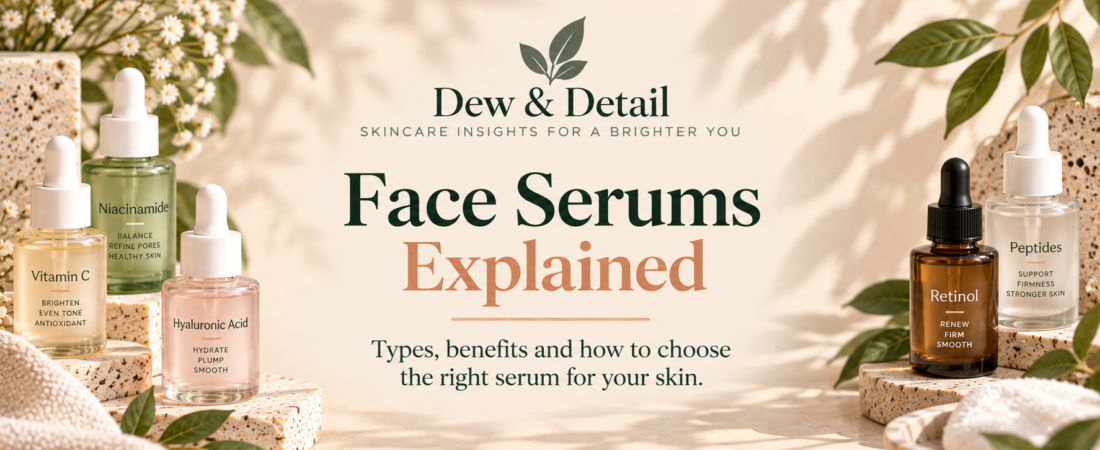
Walk into any skincare aisle and you’ll find a serum for almost everything.
Hydration. Brightening. Fine lines. Dark spots. Pores. Firmness. Acne. Barrier repair.
With so many options and so many face serums explained in different ways online, it’s easy to assume that a good skincare routine needs several different serums.
It doesn’t.
A serum is simply a lightweight skincare format that typically contains ingredients chosen to address specific skin concerns. The word serum doesn’t tell you what a product actually does.
The ingredients do.
So instead of asking:
“Which serum is best?”
A better question is:
“What is my main skin concern — and which ingredient actually targets it?”
Once you start choosing serums this way, the category becomes much easier to understand.
Table of Contents
Face Serums at a Glance
| Serum Type | Main Concern | Common Ingredients |
|---|---|---|
| Hydrating serum | Dehydration, tightness | Hyaluronic acid, glycerin, panthenol |
| Vitamin C serum | Dullness, uneven-looking tone, antioxidant support | Vitamin C |
| Niacinamide serum | Uneven tone, barrier support, oiliness | Niacinamide |
| Retinoid serum | Fine lines, texture, visible photoaging | Retinol, retinal |
| Exfoliating serum | dullness, rough texture, clogged pores | AHA, BHA, PHA |
| Peptide serum | Supportive anti-aging care | Peptides |
| Barrier-support serum | Dry, stressed or irritated-feeling skin | Ceramides, panthenol, humectants |
| PDRN serum | Emerging skin-repair and hydration category | PDRN |
| Azelaic acid serum | Acne, redness, post-acne marks, uneven-looking tone | Azelaic acid |
| Brightening serum | Dark spots, uneven-looking tone, post-acne marks | Tranexamic acid, alpha arbutin, licorice root |
Dew & Detail note: One serum can fit several categories. A niacinamide serum might also contain hydrating ingredients, while a peptide serum may contain hyaluronic acid. Always consider the whole formula, not just the ingredient highlighted most prominently on the label.
Types of Face Serums: Which One Does Your Skin Need?
Not necessarily.
A serum is an optional treatment step, rather than something every skincare routine must contain.
If your existing routine already meets your skin’s needs, you don’t need to add another product simply because serums are popular.
A serum becomes useful when it fills a specific gap.
For example:
Dehydrated skin → hydrating serum
Dullness or antioxidant support → vitamin C serum
Fine lines and visible photoaging → retinol or retinal serum
Clogged pores → salicylic acid serum
This approach is much more useful than buying a bottle labelled “glow serum” without knowing which ingredients are actually doing the work.
1. Hydrating Serums
Hydrating serums are designed primarily to increase hydration and help skin feel softer, more comfortable and more supple.
Common ingredients include:
- Hyaluronic acid
- Glycerin
- Panthenol
- Other humectants
Who may benefit from a hydrating serum?
Consider one if your skin frequently feels:
- Tight
- Dehydrated
- Rough
- Dull
- Less supple
And remember: oily skin can still be dehydrated.
Oil and water are not the same thing. Your skin can produce plenty of sebum while still benefiting from additional hydration.
Does a hydrating serum replace moisturizer?
Not necessarily.
Humectants such as glycerin and hyaluronic acid help support hydration, while moisturizers often combine humectants with emollient and/or occlusive ingredients that soften skin and help reduce water loss.
For dry or dehydration-prone skin, that might be using:
Hydrating serum → Moisturizer
rather than choosing one or the other.
Hydrating Serums To Consider
| Serum | Type | Best For |
|---|---|---|
| Torriden DIVE-IN Low Molecular Hyaluronic Acid Serum | K-Beauty | Dehydrated, oily/ combination or sensitive skin; lightweight all-round hydration |
| AESTURA ATOBARRIER365 Hydro CERA-HA Serum | K-Beauty | Dry, sensitive or barrier-compromised skin |
| Neutrogena Hydro Boost Ultra-Hydrating Serum | Alternative | Dehydrated or mature skin wanting extra hydration and a plumper feel |
2. Vitamin C Serums
Vitamin C is one of the best-known antioxidant ingredients in skincare.
It is commonly used for:
- Dullness
- Uneven-looking tone
- Visible signs of photoaging
- Antioxidant support
Research supports topical vitamin C as a potentially useful ingredient for uneven-looking tone and visible signs of photoaging, although results depend heavily on formulation and consistent use.
What does vitamin C do?
A well-formulated vitamin C product may help skin appear brighter and more even-looking while providing antioxidant support.
But there is one important distinction:
Vitamin C is not a replacement for sunscreen.
Think of them as having different jobs:
Vitamin C = antioxidant support
Sunscreen = UV protection
Is a higher vitamin C percentage always better?
No.
Vitamin C can be challenging to formulate effectively. The form of vitamin C, concentration, stability, packaging and complete formulation can all influence how a product performs.
So don’t judge a vitamin C serum solely by the percentage highlighted more prominently on the label.
Vitamin C Serums to Consider
| Serum | Type | Best For |
|---|---|---|
| Beauty of Joseon Light On Serum: Centella + Vita C | K-Beauty | Sensitive skin or vitamin C beginners; dullness & uneven-looking tone |
| Timeless 20% Vitamin C + E Ferulic Acid Serum | Alternative / Budget | Experienced vitamin C users; antioxidant support & brighter-looking skin |
| SkinCeuticals C E Ferulic | Alternative / Premium | Normal-to-dry or mature skin seeking antioxidant support & help with visible photoaging |
3. Niacinamide Serums
Niacinamide is a form of vitamin B3 and one of skincare’s more versatile ingredients.
Depending on the formulation, niacinamide may be useful for concerns involving:
- Uneven-looking tone
- Barrier support
- Texture
- Oiliness
- Visible signs of aging
Does everyone need 10% niacinamide?
No.
Higher percentages are not automatically better.
If a high-strength niacinamide serum repeatedly leaves your skin feeling irritated, itchy or uncomfortable, a gentler formula or lower concentration may suit you better.
Skincare isn’t a competition for the highest percentage.
Niacinamide Serums to Consider
| Serum | Type | Best For |
|---|---|---|
| Beauty of Joseon Glow Serum: Propolis + Niacinamide | K-Beauty | Oily/combination skin; hydration, excess oil & the appearance of pores |
| Anua Niacinamide 10 + TXA 4 Serum | K-Beauty | Post-acne marks, dark spots & uneven-looking tone |
| The Ordinary Niacinamide 10% + Zinc 1% | Alternative / Budget | Oily skin; excess oil & the appearance of pores |
4. Retinol and Retinal Serums
Retinoid serums are among the more treatment-focused products in this guide.
Two cosmetic retinoids you’ll commonly encounter are:
- Retinol
- Retinal (retinaldehyde)
They are commonly used for concerns such as:
- Fine lines
- Wrinkles
- Uneven-looking tone
- Rough texture
- Visible photoaging
Retinoids are among the better-studied topical ingredients for improving visible signs of photoaging, including fine lines and uneven skin texture.
Do you need both retinol and retinal?
Generally, no.
Retinol and retinal are generally alternatives rather than products you need to use together in the same routine.
Instead, choose an appropriate retinoid and introduce it gradually according to the product instructions and your skin’s tolerance.
Related guide: Retinol vs Retinal: What’s the Difference & Which Should You Use?
Important Pregnancy Note:
Retinoids should be avoided during pregnancy. The American Academy of Dermatology advises avoiding prescription retinoids as well as over-the-counter products containing retinol during pregnancy. If you’re pregnant or planning a pregnancy, check with your healthcare professional before using a retinoid skincare product.
Retinol and Retinal Serums to Consider
| Serum | Type | Best For |
|---|---|---|
| Celimax The Vita-A Retinol Shot Tightening Serum | K-Beauty / Retinoid Blend | Experienced retinoid users; uneven texture & visible signs of aging |
| Some By Mi Retinol Intense Reactivating Serum | K-Beauty / Retinol | Retinol beginners wanting a gentler-feeling K-beauty option for texture & early visible signs of aging |
| Medik8 Crystal Retinal 3 | Alternative / Premium / Retinal | Beginners through experienced retinal users who want a choice of progressive strengths |
| Geek & Gorgeous A-Game 5 | Alternative / Retinal | Those wanting a straightforward, more affordable retinal option with a choice of strengths |
| The Ordinary Retinal 0.2% Emulsion | Alternative / Budget / Retinal | Experienced retinoid users seeking a higher-strength retinal option |
| Beauty of Joseon Revive Eye Serum: Ginseng + Retinal | K-Beauty / Retinal Eye Serum | Those wanting retinal specifically formulated for the eye area |
5. Exfoliating Serums
Exfoliating serums commonly contain AHAs, BHA or PHA, either alone or in combination.
AHAs
Examples include:
- Glycolic acid
- Lactic acid
- Mandelic acid
They are commonly used for:
- Dull-looking skin
- Rough surface texture
- Uneven-looking tone
BHA
The BHA most commonly used in skincare is:
Salicylic acid
It is commonly used for concerns such as:
- Clogged pores
- Blackheads
- Whiteheads
- Acne-prone skin
For a closer comparison of these two exfoliating acids, see our AHA vs BHA guide to understand how they differ and which may suit your skin concerns.
PHA
PHAs are generally gentler surface exfoliants because of their larger molecular size.
Common examples include:
- Gluconolactone
- Lactobionic acid
They may be worth considering for people who want gentler exfoliation, particularly those with dry or sensitive skin.
The biggest mistake with exfoliating serums isn’t necessarily choosing the wrong acid.
It’s accidentally exfoliating with several products at once.
If your cleanser, toner, pads, serum and mask all contain exfoliating ingredients, your routine may be doing far more than you realize.
Want to explore beyond AHAs and BHAs? Our Exfoliating Ingredients Guide covers AHAs, BHAs, PHAs, enzymes, physical exfoliants, and how to choose the right option for your skin.
Exfoliating Serums to Consider
| Serum | Type | Best For |
|---|---|---|
| COSRX The AHA 2 BHA 2 Blemish Treatment Serum | K-Beauty / AHA + BHA + PHA | Congestion, uneven texture & blemish-prone skin |
| SOME BY MI AHA•BHA•PHA 30 Days Miracle Serum | K-Beauty / AHA + BHA + PHA | Those wanting a Korean multi-acid serum with a gentler positioning |
| Paula’s Choice RESIST Advanced Smoothing Treatment 10% AHA | Alternative / 10% AHA + 0.5% BHA | Normal-to-dry skin; dullness, rough texture & visible signs of sun damage |
| Drunk Elephant T.L.C. Framboos Glycolic Night Serum | Alternative / Premium / AHA + BHA | Experienced acid users; dullness, uneven texture & congestion |
6. Peptide Serums
Peptides are short chains of amino acids and are frequently included in skincare products marketed for concerns such as:
- Firmness
- Fine lines
- Elasticity
- Collagen support
But there’s an important detail.
“Peptide” does not describe one single ingredient with one single effect.
Different peptides have different structures and proposed functions.
That means a peptide serum shouldn’t automatically be interpreted as:
“This will rebuild all the collagen my skin has lost.”
Peptide-containing products may provide supportive cosmetic benefits, depending on the specific peptides and overall formulation, but expectations should remain realistic.
Who might consider a Peptide serum?
Someone looking for:
- Gentle supportive anti-aging care
- Additional hydration
- A non-retinoid supportive step
may enjoy incorporating one.
But peptide serums shouldn’t be treated as products that physically lift significantly sagging tissue or as literal “Botox in a bottle.”
Peptide Serums to Consider
| Serum | Type | Best For |
|---|---|---|
| COSRX The 6 Peptide Skin Booster Serum | K-Beauty | Combination, oily or dehydrated skin; hydration & supportive anti-aging care |
| The Ordinary Multi-Peptide + HA Serum | Alternative/ Budget | Fine lines, hydration & budget-friendly peptide care |
| Medik8 Liquid Peptides Advanced MP – Peptide Serum | Alternative/ Premium | Mature, normal-to-dry skin; fine lines & premium peptide-focused care |
7. Barrier-Supporting Serums
Not every useful serum needs to contain a powerful treatment ingredient.
Sometimes your skin needs less treatment and more support.
Barrier-focused serums may contain ingredients such as:
- Ceramides
- Glycerin
- Panthenol
- Humectants
- Soothing ingredients
- Skin-supportive lipids
These formulas may be particularly useful when skin feels:
- Dry
- Tight
- Irritated
- Over-exfoliated
- Stressed by active ingredients
If your skin is already burning, stinging and peeling, adding another strong acid serum usually isn’t the solution.
Barrier-Supporting Serums to Consider
| Serum | Type | Best For |
|---|---|---|
| PURITO Mighty Bamboo Panthenol Serum | K-Beauty | Sensitive, irritated-feeling or over-treated skin needing soothing + barrier support |
| AESTURA ATOBARRIER365 Hydro Cera-HA Serum | K-Beauty | Dry/dehydrated skin needing hydration + barrier support |
| The Ordinary Soothing & Barrier Support Serum | Alternative | Stressed or irritated-looking skin needing barrier support |
8. PDRN Serums
PDRN has become increasingly visible in Korean skincare.
Topical PDRN products are often marketed around:
- Skin recovery
- Elasticity
- Hydration
- Skin-repair claims
- Anti-aging
But this is a category where marketing claims require some caution.
Research involving medical or injectable PDRN should not automatically be treated as proof that every topical PDRN serum produces the same results.
Formulation and delivery matter.
For that reason, rather than making sweeping claims here, we examine the evidence more closely in our complete PDRN guide:
What Is PDRN & What Does It Actually Do for Skin?
PDRN Serums to Consider
| Serum | Type | Best For |
|---|---|---|
| Anua PDRN Hyaluronic Acid Capsule 100 Serum | K-Beauty | Dehydrated skin; hydration & a plumper, more radiant appearance |
| Medicube Ultra Light PDRN Pink Peptide Serum | K-Beauty | Oily/ combination skin, lightweight hydration & uneven-looking tone |
| VT PDRN 100 Essence | K-Beauty | Dry or mature skin; hydration, barrier support & loss of firmness |
| COSRX 5 PDRN Collagen Intense Vitalizing Serum | K-Beauty | Firmness, glow & uneven tone |
9. Azelaic Acid Serums
Azelaic acid is used in skincare for concerns involving:
- Acne
- Redness
- Post-acne marks
- Uneven pigmentation
Although azelaic acid also comes in creams and gels, it is increasingly found in serum-style products.
Someone whose primary concerns are acne and discoloration may therefore find azelaic acid more relevant than a trendy anti-aging serum.
It’s another good example of why it makes more sense to choose skincare by concern and ingredient, rather than by product category alone.
Azelaic Acid Serums to Consider
| Serum | Type | Best For |
|---|---|---|
| Anua Azelaic Acid 10 Hyaluron Redness Soothing Serum | K-Beauty | Acne-prone, oily or sensitive skin; redness & post-acne marks |
| Medicube Azelaic Acid 10 Soothing Serum | K-Beauty | Redness, blemishes & post-acne marks |
| COS DE BAHA AZ Azelaic Acid 10% Serum | Alternative / Budget | Oily, blemish-prone skin; redness, post-acne marks & uneven-looking tone |
| Naturium Azelaic Acid Derivative Complex 10% Serum | Alternative | Uneven-looking tone, redness, excess oil & texture |
10. Brightening Serums
“Brightening serum” sounds like a specific type of treatment.
It isn’t.
Brightening is a marketing category, not one individual ingredient.
A brightening serum might contain:
- Vitamin C
- Niacinamide
- Azelaic acid
- Alpha arbutin
- Tranexamic acid
- Licorice-derived ingredients
- Other pigment-targeting ingredients
So whenever you see BRIGHTENING SERUM on the front of a bottle, turn it around.
Ask:
Which ingredient is actually doing the brightening?
That tells you much more about the product than the word brightening itself.
Brightening Serums to Consider
| Serum | Type | Best For |
|---|---|---|
| Numbuzin No.5+ Vitamin Concentrated Serum | K-Beauty | Best all-rounder for dark spots, post-acne marks & uneven tone |
| Anua Niacinamide 10 + TXA 4 Serum | K-Beauty | Post-acne pigmentation, stubborn-looking dark spots & uneven tone |
| Eucerin Radiant ToneDark Spot Corrector Dual Serum | Alternative | Persistent-looking hyperpigmentation & dark spots |
Which Serum Is Best for Your Skin Type?
Your skin type matters, but your main concern matters too.
Two people with oily skin may need completely different serums.
Here’s how to narrow it down.
Which Serum Is Best for Dry Skin?
Dry skin often benefits from ingredients that support hydration and the skin barrier.
Look for ingredients such as:
- Glycerin
- Hyaluronic acid
- Ceramides
- Panthenol
Dry skin can still use treatment ingredients such as retinoids or exfoliating acids, but you may need to introduce potentially irritating products more cautiously.
Dry Skin Serums to Consider
| Serum | Type | Why |
|---|---|---|
| Beauty of Joseon Calming Barrier Serum | K-Beauty | Glycerin + hyaluronic acid + panthenol + ceramide NP; hydration and barrier support |
| The Ordinary Hyaluronic Acid 2% + B5 (with Ceramides) | Alternative | Hyaluronic acid + panthenol/B5 + ceramides; hydration and barrier support |
| CeraVe Hydrating Hyaluronic Acid Serum | Alternative | Hyaluronic acid + panthenol + three ceramides; hydration and barrier support for dry skin |
Which Serum Is Best for Oily Skin?
Oily skin doesn’t automatically need an “oil-control serum.”
Choose according to your actual concern.
Oily + clogged pores
Consider:
Salicylic acid
Oily + uneven-looking tone
Consider:
Niacinamide or another appropriate pigment-targeting ingredient.
Oily + dehydrated
Consider:
A lightweight hydrating serum
because oily skin can still be dehydrated.
Oily Skin Serums to Consider
| Serum | Type | Why |
|---|---|---|
| Beauty of Joseon Glow Serum: Propolis + Niacinamide | K-Beauty | 2% niacinamide + BHA + glycerin + sodium hyaluronate; oil balance, hydration & appearance of pores |
| The Ordinary Niacinamide 10% + Zinc 1% | Alternative | 10% niacinamide + 1% zinc PCA; excess oil and visible congestion |
| The Ordinary Salicylic Acid 2% Solution | Alternative | 2% salicylic acid; clogged pores, blackheads & visible congestion |
Which Serum Is Best for Acne-Prone Skin?
It depends on the concern.
For blackheads and whiteheads, salicylic acid may be useful.
For acne accompanied by redness or post-acne marks, azelaic acid may be relevant.
But persistent inflammatory, painful or scarring acne deserves appropriate medical assessment and treatment rather than an endless rotation of cosmetic serums.
A serum is not automatically an acne treatment simply because it says “acne-prone skin” on the bottle.
Acne-Prone Skin Serums to Consider
| Serum | Type | Why |
|---|---|---|
| Anua Azelaic Acid 10 Hyaluron Redness Soothing Serum | K-Beauty | 10% azelaic acid + hydrating ingredients; redness + post-acne marks & uneven-looking skin |
| The Ordinary Salicylic Acid 2% Solution | Alternative | 2% salicylic acid; blackheads, whiteheads, clogged pores & visible congestion |
| The Ordinary Aloe 2% + NAG 2% Solution | Alternative | 2% aloe + 2% NAG + peptide; post-acne marks, uneven-looking tone & barrier/hydration support |
Which Serum Is Best for Sensitive Skin?
There is no single ingredient that makes something a “sensitive skin serum.”
Sensitive skin often benefits from routines that are:
- Simple
- Introduced gradually
- Focused on hydration and barrier support
- Mindful of potential irritants
A hydrating or barrier-supporting serum may be useful.
But even a product marketed as “soothing” can cause a reaction in some people.
The American Academy of Dermatology recommends testing new skincare products on a small area before incorporating them fully into your routine.
Sensitive Skin Serums to Consider
| Serum | Type | Why |
|---|---|---|
| PURITO Wonder Releaf Centella Serum Unscented | K-Beauty | Centella + panthenol + allantoin + ceramide NP; soothing hydration & barrier support |
| Aveeno Calm + Restore Triple Oat Serum | Alternative | Triple Oat complex + feverfew; soothing hydration for dry, sensitive or easily irritated skin |
| PURITO Mighty Bamboo Panthenol Serum | K-Beauty | 13% panthenol + squalane + ectoin; intensive hydration & moisture-barrier support |
Which Serum Is Best for Mature Skin?
Don’t choose a serum simply because the bottle says “50+” or “Mature skin.”
Identify what you actually want to improve.
Fine lines and rough texture
Consider:
Dullness or uneven-looking tone
Consider:
Vitamin C or another appropriate tone-targeting ingredient.
Dehydration or a crepey appearance
Consider:
Hyaluronic acid, glycerin and barrier-supportive ingredients
Additional supportive anti-aging care
Consider:
Peptides
The best mature-skin routine isn’t necessarily the one containing the greatest number of serums.
In fact, evidence-based reviews of photoaging emphasize photoprotection and retinoids as core approaches, with ingredients such as vitamin C, niacinamide and AHAs added according to individual concerns.
Mature Skin Serums to Consider
| Serum | Type | Why |
|---|---|---|
| COSRX The 6 Peptide Skin Booster Serum | K-Beauty | 6 peptides + hydrating ingredients; hydration, elasticity & supportive anti-aging care |
| Medik8 Crystal Retinal 3 | Alternative / Premium / Retinal | 0.03% retinal; fine lines, uneven texture & visible signs of photoaging |
| Beauty of Joseon Light On Serum: Centella + Vita C | K-Beauty | Vitamin C derivative + centella; dullness, uneven-looking tone & antioxidant support |
Can You Use More Than One Serum?
Yes.
But you don’t automatically need to.
For example, someone might reasonably use:
Morning → Vitamin C serum
Evening → Retinoid serum
while keeping everything else relatively simple.
What you shouldn’t assume is that a good skincare routine requires:
Vitamin C + niacinamide + peptides + hyaluronic acid + retinol + exfoliating serum
all at once.
Every additional product introduces another:
- Ingredient interactions
- Expense
- Potential source of irritation
- Step to maintain
Before adding another serum, ask:
What job is this product doing that my existing routine isn’t already doing?
If you can’t answer that question, you may not need it.
What Order Should You Apply Serums?
Serum layering is often made more complicated than necessary.
A simple general morning routine is:
Cleanser → Serum/Treatment → Moisturizer → Sunscreen
The exact order can vary depending on:
- The products you use
- Prescription treatments
- Product directions
- Formulation and texture
If you use multiple serums, lighter formulas are often applied before heavier ones.
However, specific product and treatment instructions matter more than blindly following a “thinnest to thickest” rule.
Serum Before or After Moisturizer?
Most lightweight serums are applied before moisturizer.
A basic routine might look like:
Cleanser → Serum → Moisturizer → Sunscreen (morning)
There are exceptions.
For example, someone introducing a potentially irritating retinoid may use moisturizer strategically according to their product directions and skin tolerance.
Do You Need a Serum in the Morning and at Night?
No.
Your serum should have a purpose — not a schedule based on what someone else’s routine looks like.
You might use:
Vitamin C in the morning
and
Retinol at night.
Or you might use one serum once a day.
Or no serum at all.
All can be perfectly reasonable routines.
Can Serums Damage Your Skin Barrier?
The word serum isn’t the problem.
What matters is what’s inside the serum and how you use it.
Using several potentially irritating actives at the same time — such as exfoliating acids, retinoids and acne treatments — may overwhelm some skin.
Pay attention to persistent:
- Burning
- Redness
- Stinging
- Excessive peeling
- Tightness
- Increased sensitivity
Those symptoms aren’t proof that your skincare is “working harder.”
They may be a sign that your routine needs to be simplified.
How Many Serums Do You Really Need?
There is no universal number.
For many people, however, zero to two targeted serums can be plenty.
That isn’t a medical rule.
It’s simply a practical way to avoid turning your skincare routine into a collection of overlapping products.
For example:
Morning → Vitamin C | Evening → Retinoid
Someone with different concerns might choose:
Morning → Niacinamide | Evening → Azelaic acid
The exact combination isn’t the point.
The principle is:
Every serum should have a reason to be there.
7 Common Serum Mistakes
1. Buying the word “serum”
A product isn’t automatically more effective because it comes in a dropper bottle.
Look at the ingredients and formulation.
2. Using several serums to target every concern at once
Your skin doesn’t need every concern treated simultaneously.
Prioritize.
3. Choosing percentages instead of formulations
Higher numbers don’t automatically guarantee better results.
4. Introducing several new products at once
If your skin reacts, you may have no idea which product caused it.
5. Expecting a hydrating serum to replace moisturizer
Some skin still benefits from a moisturizer that helps soften the skin and reduce water loss.
6. Expecting peptide serums to physically lift sagging skin
Supportive cosmetic benefits and structural lifting are not the same thing.
7. Buying according to trends
The serum going viral this month isn’t automatically relevant to your skin.
The Dew & Detail Serum Method
Before buying another serum, ask yourself four questions.
1. What is my MAIN concern?
Pick the concern that matters most right now.
Not five.
2. Which ingredient targets that concern?
That’s what you should investigate — not simply the claims printed on the front of the bottle.
3. Do I already have that ingredient somewhere else?
Check your:
- Cleanser
- Toner
- Essence
- Moisturizer
- Existing treatments
You may already be getting what you need.
4. Can my skin tolerate it alongside everything else?
This matters more than how exciting an ingredient sounds.
Remember:
Concern → Ingredient → Formulation → Routine
Not:
Trend → Buy → Add → Hope.
Face Serums: Frequently Asked Questions
Are face serums necessary?
No. Serums are optional skincare products. A good routine does not automatically need one.
Which serum should I use first?
Choose according to your primary concern. If dehydration is your biggest issue, consider a hydrating serum. If dullness or uneven-looking tone is the concern, ingredients such as vitamin C or niacinamide may be more relevant.
Can I use two serums together?
Often, yes, depending on the ingredients and formulations. But more products are not automatically better.
Is Hyaluronic acid a serum?
No. Hyaluronic acid is an ingredient.
It is commonly sold in serum formulations, but it can also appear in toners, essences, moisturizers and other products.
Is Niacinamide good for oily skin?
It can be useful in routines for oily skin, but niacinamide has broader functions too, including barrier and tone support.
Which serum is best for wrinkles?
Retinoids are among the better-supported topical options for visible photoaging and fine lines. Hydrating and peptide products may provide additional supportive cosmetic benefits.
Which serum gives glowing skin?
That depends on what is making the skin look dull.
For dullness or uneven-looking tone, vitamin C or an appropriate exfoliating ingredient may help improve the appearance of radiance.
If dehydration is the issue, a hydrating serum may make skin appear smoother and more radiant.
Can I use a serum every day?
It depends on the product.
A basic hydrating serum may be suitable for frequent use, while retinoids and stronger exfoliating products may need to be introduced gradually.
Should I use serum before sunscreen?
Generally, yes.
A typical morning routine is:
Cleanser → Serum → Moisturizer → Sunscreen
Is an expensive serum better?
Not necessarily.
Price alone tells you very little about whether a formula is effective, well-designed or appropriate for your skin.
The Dew & Detail Takeaway
A serum isn’t a skincare requirement.
It’s a product format.
What matters is what’s inside the bottle and whether those ingredients address something your skin actually needs.
Think:
Hyaluronic acid or glycerin → Hydration
Vitamin C → Antioxidant and brightening support
Niacinamide → Tone and barrier support
Retinoids → Visible photoaging and texture
AHA or BHA → Exfoliation & congestion support
Peptides → Supportive anti-aging care
And don’t assume you need all of them.
The smartest serum routine isn’t the longest one.
It’s the one where you can look at every bottle on your shelf and answer:
“Why am I using this?”
Sources & Further Reading
- American Academy of Dermatology — Retinoid or retinol?
- American Academy of Dermatology — Dermatologist-approved pregnancy skin care
- American Academy of Dermatology — How to test skin care products
- Photoaging and Topical Rejuvenation — Facial Plastic Surgery Clinics of North America
- Efficacy of Topical Vitamin C in Melasma and Photoaging: A Systematic Review — Journal of Cosmetic Dermatology
- Cosmetic Retinoid Use in Photoaged Skin: A Review of the Compounds, Their Use and Mechanisms of Action
- Niacinamide: a review on dermal delivery strategies and clinical evidence — Drug Delivery and Translational Research
- A Systematic Review to Evaluate the Efficacy of Azelaic Acid in the Management of Acne, Rosacea, Melasma and Skin Aging — Journal of Cosmetic Dermatology
- Anti-ageing Peptides and Proteins for Topical Applications: A Review — Pharmaceutical Development and Technology
Medical disclaimer:
This article is for general educational purposes and is not a substitute for medical advice, diagnosis or treatment. If you have persistent acne, significant irritation, a skin condition, are pregnant, or use prescription treatment, consult an appropriate healthcare professional.