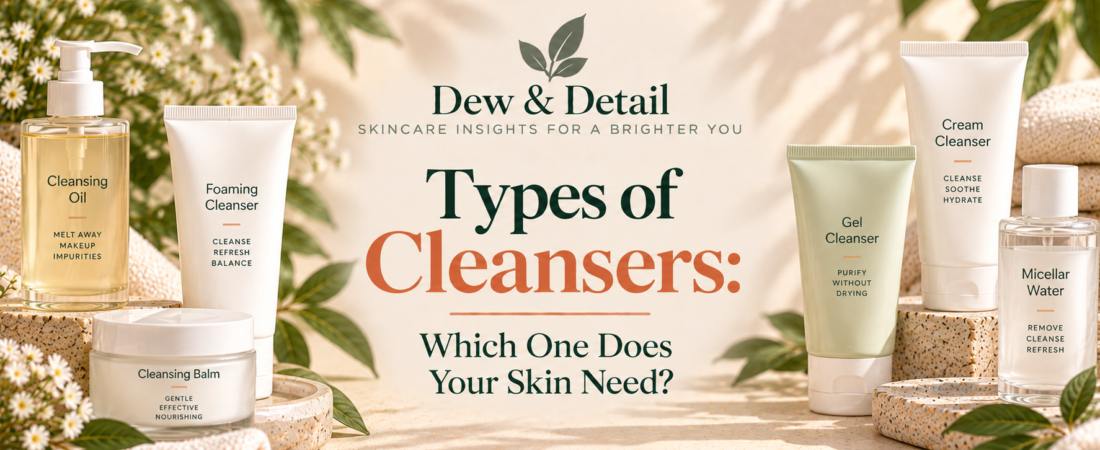
Cleansing sounds like one of the simplest steps in skincare: apply cleanser, rinse it away and move on to the rest of your routine.
Choosing between the different types of cleansers can quickly become confusing. There are gel cleansers, foaming cleansers, creams, cleansing milks, oils, balms, micellar waters, cleansing pads, powder cleansers and treatment cleansers containing ingredients such as salicylic acid or benzoyl peroxide. Newer products may also be described as amino acid cleansers, microbiome-friendly cleansers, mochi cleansers, jelly cleansers or transforming cleansers.
So which type does your skin actually need?
The answer depends on more than whether your skin is oily or dry.
A cleanser can be described in several ways at the same time. One product might be a water-based, foaming, low-pH cleanser, while another might be a gel cleanser containing an exfoliating active.
Understanding the different types of cleansers makes it easier to choose a formula based on what your skin actually needs.
The goal is not to find the cleanser that removes the greatest possible amount of oil. It is to remove what needs to be removed while leaving the skin comfortable and its barrier as undisturbed as reasonably possible.
Table of Contents
What Does a Facial Cleanser Actually Do?
Throughout the day, the skin’s surface accumulates:
- Sebum
- Sweat
- Sunscreen
- Makeup
- Skincare residue
- Environmental dirt and debris
Some of these substances are not easily removed by water alone. This is where cleansers—and particularly ingredients called surfactants—become useful.
Surfactants help oily material and other debris become dispersed in water so they can be removed from the skin. However, surfactants can also interact with components of the stratum corneum, which is why the formulation of a cleanser matters.
What Are Surfactants?
Surfactants are cleansing agents that help water interact with oils and debris.
In simplified terms, part of a surfactant molecule interacts more readily with water while another part interacts more readily with oils.
Not every surfactant behaves in the same way.
Anionic surfactants carry a negative charge and can provide effective cleansing and foaming. Their mildness varies considerably.
Amphoteric surfactants can behave differently depending on their environment and are commonly combined with other surfactants in cleansing formulas.
Nonionic surfactants carry no electrical charge and are also used in cleansing and emulsifying systems.
Most modern cleansers use a combination of surfactants, rather than relying on a single cleansing agent. Surfactant structure, concentration, charge, micelle behavior and the way surfactants are combined can all influence how a cleansing system interacts with skin.
This is why reading one surfactant name on an ingredient list cannot reliably tell you exactly how gentle or harsh the finished cleanser will be.
Why Can Cleansing Leave Skin Tight or Dry?
A cleanser needs to remove unwanted material, but overly aggressive cleansing can also interact with skin proteins and remove some of the lipids and natural moisturizing components that help support the outer skin barrier.
This may contribute to:
- Tightness
- Dryness
- Roughness
- Flaking
- Stinging
- Irritation
- Increased sensitivity
If your skin feels extremely tight after every wash, that is not necessarily evidence that your cleanser has done an excellent job.
Clean skin does not need to feel stripped or “squeaky clean.”
At the same time, it is too simplistic to label an entire category—such as every foaming cleanser—as harsh.
The complete formulation matters more than the amount of foam alone.
Types of Cleansers Explained
One of the easiest ways to understand cleansers is by their format or texture.
However, these categories can overlap with characteristics such as pH, active ingredients, cleansing strength and intended purpose.
1. Gel Cleansers
Gel cleansers have a lightweight, water-based gel or jelly-like texture. They are often associated with oily and combination skin, but “gel” describes the cleanser’s texture—not how strong or drying it will be.
Some gel cleansers produce noticeable foam and are designed to remove excess oil, sweat and everyday residue efficiently. Others are low-foaming or almost non-foaming and contain humectants and milder cleansing systems intended to leave the skin feeling more comfortable after rinsing. This means two products labelled “gel cleanser” can behave very differently on the skin.
Gel cleansers can be particularly practical as an everyday water-based cleanse because they rinse away easily and generally leave less of a creamy or oily after-feel than richer cleanser formats. They can also work well as the second step of a double cleanse after makeup or resistant sunscreen has already been removed.
Who may like them?
Oily and combination skin often enjoys the lightweight finish of a gel cleanser, but gentle hydrating gels can also suit normal, dehydrated and sensitive skin. The better question is not simply whether your skin is oily or dry, but how much cleansing your skin needs and how it feels afterward.
If a gel cleanser consistently leaves your face tight, squeaky, dry or uncomfortable, that particular formula may be more cleansing than your skin needs. On the other hand, if a very mild gel leaves behind makeup, resistant sunscreen or noticeable residue, you may need a more effective first-cleansing step rather than simply washing harder.
Gel vs foam: A gel cleanser refers primarily to the product’s starting texture, while “foaming” describes what happens during use. A cleanser can therefore be both a gel and a foaming cleanser.
Gel Cleansers Worth Considering:
| Product | Why Consider It | Best For |
|---|---|---|
| Beauty of Joseon Green Plum Refreshing Cleanser | pH-balanced gentle gel with plum water and mung bean extract | Everyday gentle cleansing; most skin types |
| ROUND LAB 1025 Dokdo Cleansing Gel | Lightweight, hydration-focused low-pH gel | Dehydrated, combination or sensitive skin |
| Haruharu Wonder Black Rice Moisture 5.5 Soft Cleansing Gel Unscented | Unscented, mildly acidic soft gel | Sensitive, dehydrated or easily stripped skin |
| COSRX Low pH Good Morning Gel Cleanser | Established low-pH K-beauty gel cleanser | Normal, combination or oily skin |
| KraveBeauty Matcha Hemp Hydrating Cleanser | Low-foaming hydrating gel | Normal, dry, dehydrated or sensitive skin |
| Geek & Gorgeous Jelly Joker | Minimalist, low-foaming jelly cleanser | Sensitive or barrier-stressed skin |
| Prequel Gleanser Non-Drying Glycerin Cleanser | Glycerin-rich cleanser designed to minimize a stripped feeling | Dry, dehydrated or barrier-stressed skin |
| Vanicream Gentle Facial Cleanser | Straightforward fragrance-free cleanser | Normal, combination or sensitive skin |
| Neutrogena Hydro Boost Hydrating Cleansing Gel Fragrance Free | Accessible hydrating gel with glycerin and hyaluronic acid | Normal-to-dry or dehydrated skin |
| Youth To The People Superfood Cleanser | Foaming gel with botanical extracts | Normal, combination or oily skin |
| Tower 28 SOS Gel Face Wash | Gentle daily gel developed with sensitive skin in mind | Sensitive, reactive or combination skin |
Beauty of Joseon’s current official page confirms the cleanser is pH-balanced, suitable for all skin types and clinically tested for sensitive skin.
Worth remembering: Gel describes the cleanser’s texture, not its cleansing strength. Some gels remove more oil, while others are specifically formulated to minimize dryness.
2. Foaming Cleansers
Foaming cleansers produce bubbles or lather when mixed with water and massaged over the skin. They can begin as gels, creams, liquids or dense pastes, which is why “foaming cleanser” describes cleansing behaviour rather than one single texture.
Foaming cleansers are often good at removing sweat, excess sebum and everyday residue and can leave a particularly fresh, clean-feeling finish. For this reason, they are commonly marketed to oily, combination and acne-prone skin.
But foam itself does not tell you whether a cleanser is harsh.
Modern foaming cleansers can combine different surfactants with humectants, emollients and barrier-supportive ingredients. Some produce abundant foam while remaining relatively mild, while another cleanser may leave the skin noticeably tight. The overall surfactant system, its concentration, pH and complete formula matter more than the amount of lather you see.
Who may like them?
People with oily or combination skin often enjoy foaming cleansers because of their clean-rinsing finish. However, well-formulated gentle foams can also work for normal, dehydrated and even sensitive skin.
The warning sign is not “this cleanser foams.” It is how your skin behaves afterward. Persistent tightness, roughness, dryness, burning or discomfort can indicate that the cleanser is more aggressive than your skin currently needs.
Foaming Cleansers Worth Considering:
| Product | Why Consider It | Best For |
|---|---|---|
| Anua Succinic Moisture Cleansing Foam | Moisture-focused Korean foam with blemish/pore-oriented ingredients | Oily or combination skin; those who prefer a fresh foaming cleanse |
| beplain Mung Bean pH-Balanced Cleansing Foam | pH-balanced mung-bean cleansing foam | Combination, oily or sensitive-leaning skin |
| Anua 8 Hyaluronic Acid Hydrating Gentle Foaming Cleanser | Hydration-focused foaming cleanser | Dehydrated or combination skin |
| SKIN1004 Madagascar Centella Ampoule Foam | Mildly acidic centella-based foam | Normal, combination or sensitive skin |
| ROUND LAB 1025 Dokdo Bubble Foam Cleanser | Mildly acidic creamy foam | Normal, combination, dehydrated or sensitive skin |
| Torriden DIVE IN Cleansing Foam | Moisture-focused Korean foaming cleanser | Dehydrated, normal or combination skin |
| AESTURA ATOBARRIER365 Gentle Foaming Cleanser | Barrier-conscious gentle foam | Dry, sensitive or barrier-stressed skin |
| Arencia Fresh Green Rice Mochi Cleanser | Dense mochi-style texture that develops into foam | Normal, combination or oily skin |
| innisfree Green Tea Amino Acid Cleansing Foam | Green-tea cleanser with an amino-acid-focused cleansing system | Normal, combination or dehydrated skin |
| LAGOM Cellup Micro Foam Cleanser | Fine, dense Korean cleansing foam | Normal, combination or oily skin |
| ma:nyo Pure & Deep Cleansing Foam | Rich Korean foaming cleanser | Normal, combination or oily skin |
| S.NATURE Aqua Rice Cleansing Foam | Rice-focused Korean cleansing foam | Normal, combination or dehydrated skin |
| KANEBO Comfort Stretchy Wash II | Stretchy, essence-like texture that produces dense cushioning foam | Normal-to-dry or dehydration-prone skin |
| CeraVe Hydrating Cream-to-Foam Cleanser | Cream-to-foam format with barrier-supportive ingredients | Normal-to-dry skin, including sensitive skin |
KANEBO’s current official page confirms its distinctive stringy texture, dense foam and hydration-focused positioning.
Worth remembering: The amount of foam does not reliably tell you whether a cleanser is gentle or harsh. The surfactant system, concentration, pH and complete formulation matter more than bubbles alone.
3. Cream Cleansers
Cream cleansers have a richer, more emollient texture than most gels and foams. They are generally designed to cleanse while reducing the stripped feeling that can occur when too much surface oil is removed.
Many are low-foaming or non-foaming and may contain humectants, emollients or lipids that help make cleansing feel more comfortable. Because of this, cream cleansers are frequently associated with dry, mature, sensitive or barrier-stressed skin.
However, “cream” is still a texture category rather than a guarantee of mildness. The cleansing agents and complete formulation determine how a product actually behaves.
Cream cleansers can work particularly well when the goal is everyday cleansing without a squeaky-clean finish. Depending on the individual formula, some can also remove light makeup or sunscreen.
Who may like them?
Dry and dehydrated skin may appreciate their richer after-feel, while sensitive or temporarily compromised skin may prefer them to a more aggressively cleansing formula. But having oily skin does not automatically mean you need to avoid cream cleansers.
If a cream cleanser leaves behind more residue than you enjoy, a lighter gel or gentle foam may suit you better.
Cream Cleansers Worth Considering:
| Product | Why Consider It | Best For |
|---|---|---|
| CeraVe Hydrating Facial Cleanser | Non-foaming cleanser with ceramides and humectants | Normal-to-dry, sensitive or barrier-stressed skin |
| La Roche-Posay Toleriane Hydrating Gentle Facial Cleanser | Gentle cream cleanser with a non-stripping approach | Normal-to-dry or sensitive skin |
| The Ordinary Glycolipid Cream Cleanser | Cream cleanser that can also help remove everyday makeup | Normal-to-dry or dehydrated skin |
| Dermalogica Intensive Moisture Cleanser | Rich moisture-focused cleanser | Dry or very dry skin |
| SkinCeuticals Gentle Cleanser | Non-foaming cream cleanser | Dry or sensitive skin |
| Drunk Elephant Mello Marula Cream Cleanser | Creamy, lipid-rich cleansing formula | Normal-to-dry or sensitive-leaning skin |
Worth remembering: Cream cleansers are often associated with dry skin, but a creamy texture alone does not determine how gentle a cleanser will be.
4. Milk & Lotion Cleansers
Cleansing milks and lotions have fluid, creamy textures that usually sit somewhere between a watery cleanser and a richer cream cleanser.
They typically emphasize gentle cleansing and skin comfort rather than maximum degreasing power. Many produce little or no foam and can be useful for skin that becomes uncomfortable with stronger cleansing systems.
Cleansing milks may remove everyday residue, light makeup and some sunscreens, although their removal ability varies substantially between formulas. They should not automatically be assumed to perform like cleansing oils simply because both can have a smooth, emollient feel.
Who may like them?
Dry, dehydrated, sensitive and mature skin often appreciates this format. They can also be useful when your skin temporarily feels more reactive than usual and you want a less aggressive cleansing experience.
Importantly, a cleansing milk is not automatically a first cleanser. Depending on its formulation and what you need to remove, it may function as your main cleanser.
Milk & Lotion Cleansers Worth Considering:
| Product | Why Consider It | Best For |
|---|---|---|
| make p:rem Safe Me Relief Moisture Cleansing Milk | Gentle moisture-focused cleansing milk | Dry, sensitive or dehydrated skin |
| ma:nyo Pure Soybean Cleansing Milk | Soft soybean-based cleansing milk | Normal, dry or dehydrated skin |
| S.NATURE Aqua Rice Cleansing Milk | Lightweight rice-focused cleansing milk | Dry, dehydrated or sensitive skin |
| Isntree Yam Root Vegan Milk Cleanser | Creamy lotion-like cleansing milk | Dry, sensitive or mature skin |
| Torriden DIVE IN Cleansing Milk | Hydration-focused cleansing milk | Dehydrated or dry skin |
| AESTURA ATOBARRIER365 Cleansing Milk | Barrier-focused cleansing milk | Dry, sensitive or barrier-stressed skin |
| Stratia Velvet Cleansing Milk | Non-foaming cushioning milk cleanser | Dry, sensitive or barrier-stressed skin |
Worth remembering: A cleansing milk is not automatically a first cleanser. Depending on the formula and what you need to remove, it can be your main cleanser.
5. Cleansing Oils
Cleansing oils work on a different principle from many conventional water-based cleansers. Their oil-rich base is particularly effective at dissolving makeup, sunscreen, sebum and other oil-soluble residue.
Most modern facial cleansing oils contain emulsifiers. When water is added, the oil turns milky and can be rinsed away rather than behaving like ordinary facial oil.
This makes cleansing oils especially useful as a first cleansing step when you wear substantial makeup, long-wearing complexion products or resistant sunscreen.
But cleansing oils are not only for dry skin. Oily and combination skin can use them too. Your skin already producing sebum does not mean an emulsifying cleansing oil is automatically unsuitable.
Likewise, cleansing oil should not be presented as a treatment that “pulls out” every blackhead or permanently cleans pores. Its primary role is cleansing and dissolving oil-soluble material, not treating acne.
Who may like them?
Anyone needing efficient makeup or sunscreen removal may find them useful. They can also reduce the need for repeated rubbing with cotton pads or wipes.
Cleansing Milk vs Cleansing Oil
| Cleansing Milk | Cleansing Oil | |
|---|---|---|
| Texture | Lightweight creamy/lotion-like | Fluid and oil-based |
| Main role | Gentle everyday cleansing | Dissolving makeup, sunscreen and oily residue |
| Makeup | Usually better suited to lighter makeup | Often better for heavier or water-resistant makeup |
| Sunscreen | Formula-dependent | Particularly useful for resistant SPF |
| Often used as | Main cleanser | First cleanse |
| Second cleanse required? | Not automatically | Not automatically |
Do Cleansing Oils Clog Pores?
Not automatically.
Whether a cleansing oil suits acne-prone or clog-prone skin depends on the complete formulation and individual response, rather than simply on the presence of oil.
If a particular cleansing oil repeatedly seems to worsen breakouts or leaves an uncomfortable residue, discontinue it and choose another removal method rather than assuming every cleansing oil will behave the same way.
Cleansing Oils Worth Considering:
I would keep this table larger. Korea and Japan are particularly strong in this category, so cutting excellent oils simply to make the table shorter would weaken the guide.
| Product | Why Consider It | Best For |
|---|---|---|
| Haruharu Wonder Black Rice Moisture Cleansing Oil Unscented | Unscented Korean emulsifying oil | Everyday makeup/SPF removal; sensitive or dryness-prone skin |
| Anua Heartleaf Pore Cleansing Oil Mild | Lightweight, fragrance-free cleansing oil formulated with sensitive skin in mind | Makeup/SPF removal; sensitive or easily irritated skin |
| SKIN1004 Madagascar Centella Light Cleansing Oil | Lightweight emulsifying oil with centella and botanical oils | Makeup, sunscreen and excess-sebum removal |
| ma:nyo Pure Cleansing Oil | Richer Korean cleansing oil | Makeup/SPF removal; normal, combination or dry skin |
| Dear, Klairs Gentle Black Fresh Cleansing Oil | Lightweight, fragrance-free oil made with 85% vegetable oils | Everyday makeup/SPF removal; sensitive or combination skin |
| PURITO From Green Cleansing Oil | Fragrance- and essential-oil-free plant-oil cleanser | Everyday makeup/SPF removal; sensitive or dryness-prone skin |
| numbuzin No.1 Easy Peasy Cleansing Oil | Lightweight Korean cleansing oil | Makeup and sunscreen removal |
| ROUND LAB 1025 Dokdo Cleansing Oil | Emulsifying Korean cleansing oil | Everyday makeup/SPF removal |
| FANCL Mild Cleansing Oil | Rich Japanese oil that removes stubborn and waterproof makeup with minimal rubbing | Waterproof makeup and resistant sunscreen |
| Attenir Skin Clear Cleanse Oil | Popular Japanese cleansing oil with strong makeup-removal positioning | Daily makeup/SPF removal |
| ORBIS The Cleansing Oil | Newer Japanese cleansing-oil option | Makeup and sunscreen removal |
| shu uemura Ultime8 Sublime Tsubaki Cleansing Oil | Premium Japanese cleansing oil with a richer sensory texture | Heavy makeup/SPF removal; those preferring a richer oil |
FANCL specifically confirms removal of stubborn and waterproof makeup without harsh rubbing. Klairs confirms its oil is 85% vegetable oil, fragrance-free, non-comedogenic and tested for sensitive skin and eye irritation. PURITO confirms that From Green is free of artificial fragrance and essential oils.
Worth remembering: Cleansing oils are primarily removal products, not acne or blackhead treatments. They can be used by oily as well as dry skin if the formula suits the user.
6. Cleansing Balms
Cleansing balms perform a similar basic job to cleansing oils but begin as a solid or semi-solid balm.
As the balm is massaged over dry skin, it melts into an oil-like layer that can dissolve foundation, sunscreen, lipstick, mascara and other oil-soluble residue. Water is then added so an emulsifying balm can turn milky and rinse away.
The biggest difference between an oil and balm is therefore often format and user experience rather than purpose.
Balms can be especially convenient for heavier makeup because their thicker texture stays where it is placed and provides cushioning during massage. Their solid format can also be less messy for travel.
However, a balm is not automatically richer, gentler or more suitable for dry skin than an oil. Formulas differ.
Cleansing Balm vs Cleansing Oil
| Cleansing Balm | Cleansing Oil | |
|---|---|---|
| Starting texture | Solid/semi-solid | Fluid |
| During massage | Melts into oil | Already oil-like |
| Main role | Makeup/SPF removal | Makeup/SPF removal |
| Travel | Often convenient | Can be messier |
| Cleansing ability | Formula-dependent | Formula-dependent |
| Second cleanse required? | Not automatically | Not automatically |
What About Waterproof Eye & Lip Makeup?
Long-wearing mascara, eyeliner and lip products may require an effective cleansing oil, balm or dedicated eye-and-lip makeup remover.
Instead of repeatedly rubbing or tugging at the delicate eye area, allow the remover time to dissolve the product before gently removing it. If a cleanser causes eye irritation, stop using it around the eyes even if it works well elsewhere on the face.
Cleansing Balms Worth Considering:
| Product | Why Consider It | Best For |
|---|---|---|
| Beauty of Joseon Radiance Cleansing Balm | Balm-to-oil cleanser with rice-bran and grain-derived ingredients | Makeup, sunscreen and eye-makeup removal |
| BANILA CO Clean It Zero Cleansing Balm Original | Iconic K-beauty makeup-removing balm | Everyday to heavier makeup/SPF removal |
| beplain Mung Bean Pore Cleansing Milk Balm | Mung-bean-focused Korean balm | Makeup/SPF removal; combination or congestion-prone skin |
| S.NATURE Aqua Rice Cleansing Balm | Rice-focused Korean balm | Makeup/SPF removal; normal or dryness-prone skin |
| Heimish All Clean Balm | Established Korean makeup-removing balm | Makeup and sunscreen removal |
| Dr. Althea Pure Grinding Cleansing Balm | Grinding dispenser with balm-to-oil texture | Makeup/SPF removal with a hygienic dispensing format |
| APRILSKIN Carrotene IPMP Hydromelt Cleansing Balm | Pore/blemish-oriented Korean balm | Makeup/SPF removal; combination or congestion-prone skin |
| Farmacy Green Clean Fragrance-Free Cleansing Balm | Fragrance-free Western cleansing balm | Makeup/SPF removal; fragrance-sensitive users |
| Clinique Take The Day Off Cleansing Balm | Fragrance-free balm tested for sensitive skin and eyes | Long-wearing makeup, SPF and sensitive eyes/skin |
Clinique confirms that its balm dissolves long-wearing makeup and SPF and is fragrance-free, non-comedogenic, dermatologist tested, ophthalmologist tested and safe for sensitive skin and eyes.
Worth remembering: Oils and balms usually perform a similar basic job. Choose according to removal ability, emulsification, formula and the texture you prefer.
7. Cleansing Pads, Wipes & Tissues
Cleansing pads, wipes and tissues are pre-moistened disposable products designed to remove makeup, surface oil or everyday residue without dispensing a separate cleanser.
Their biggest advantage is convenience. They can be useful while travelling, after exercise or in situations where conventional cleansing is difficult.
But convenience comes with limitations.
Unlike cleansing with your fingertips and water, wipes and pads rely partly on physical wiping. Repeated rubbing—particularly when trying to remove resistant mascara or long-wearing makeup—can increase friction and irritation.
They also generate more single-use waste than most bottled cleansers.
And remember: not every skincare pad is a cleansing pad. Toner pads and exfoliating pads may contain hydrating or active ingredients and are not necessarily designed to remove makeup or cleanse the skin.
For routine home cleansing, many people will find a conventional cleanser more practical and comfortable. Wipes and tissues are best viewed as a useful format for particular situations, rather than something everyone needs.
Cleansing Pads, Wipes & Tissues Worth Considering:
| Product | Format | Best For |
|---|---|---|
| ROUND LAB 1025 Dokdo Cleansing Tissue | Cleansing tissue | Convenient makeup/SPF removal or travel |
| beplain Mung Bean pH-Balanced Facial Cleansing Wipes | Cleansing wipes | Quick cleansing or travel |
| celimax Ji Woo Gae One Step Mild Cleansing Pad | Cleansing pad | Light makeup and residue removal |
| Pyunkang Yul Low pH Cleansing Pad | Cleansing pad | Convenient light cleansing |
| NEOGEN Carrot Deep Clear Remover Oil Pad | Oil-based cleansing pad | More resistant makeup or sunscreen |
| Bifesta Micellar Cleansing Sheets | Japanese cleansing sheets | Makeup removal and travel |
| Bioderma Sensibio H2O Micellar Cleansing Wipes | Micellar wipes | Convenient cleansing for sensitive skin |
| Ariul Stress Relieving Purefull Cleansing Tissue | Korean cleansing tissue | Makeup removal and convenience |
Worth remembering: Cleansing wipes and pads introduce friction and generate more single-use waste. If resistant makeup requires repeated rubbing, an oil or balm may be a better option.
8. Micellar & Cleansing Waters
Micellar waters are lightweight, water-based cleansing liquids containing surfactants that help lift oil, makeup and other residue from the skin.
They can help lift oil, makeup and residue from the skin onto a cotton pad, making them useful when you want a quick, lightweight cleansing step without the texture of an oil, balm or cream.
They are particularly popular for light makeup removal, gentle cleansing and travel.
However, micellar water is not automatically strong enough for every cleansing job. Resistant sunscreen, waterproof mascara and long-wearing makeup may require several passes, which can mean more friction. In those situations, an oil, balm or dedicated makeup remover may be more efficient.
Do You Need to Rinse Micellar Water?
Some micellar waters are marketed as no-rinse formulas. Whether you choose to rinse afterward can depend on the particular product, your skin and how comfortable it feels.
Who may like them?
People who dislike rich first cleansers, wear relatively light makeup or want a convenient cleansing option may appreciate micellar water. Different formulas are available for sensitive, dry and oilier skin.
Micellar & Cleansing Waters Worth Considering:
| Product | Why Consider It | Best For |
|---|---|---|
| Bioderma Sensibio H2O | Iconic no-rinse micellar cleansing water | Light makeup removal; sensitive, normal or dry skin |
| Bioderma Sébium H2O | Micellar water developed for oilier skin | Light cleansing; combination or oily skin |
| Garnier Micellar Cleansing Water All-in-1 | Widely available, budget-friendly micellar water | Everyday light makeup removal |
| CeraVe Hydrating Micellar Water | Hydration/barrier-focused micellar cleanser | Dry, dehydrated or sensitive skin |
| La Roche-Posay Toleriane Micellar Water | Gentle micellar cleansing option | Light cleansing; normal or sensitive-leaning skin |
| ROUND LAB 1025 Dokdo Cleansing Water | Lightweight Korean cleansing water | Light makeup/SPF removal |
| Torriden DIVE IN Cleansing Water | Hydration-focused Korean cleansing water | Light cleansing; dehydrated or sensitive-leaning skin |
Worth remembering: Cleansing waters are convenient, but resistant makeup and water-resistant sunscreen may be easier to remove with an oil or balm.
9. Powder & Enzyme Cleansers
Powder cleansers begin as a dry powder and are activated by water in your hands. Depending on the formula, they can transform into a creamy paste, light lather or foam.
The powder format has practical advantages: it can be compact, travel-friendly and requires less water in the product itself.
But powder cleanser and enzyme cleanser do not mean exactly the same thing.
Some powders function mainly as cleansers. Others contain enzymes such as protease or papain, while some combine enzymes with acids or fine particulate ingredients. These products can provide more exfoliating activity alongside cleansing.
Enzymes can help loosen or break down components of surface buildup, which is why enzyme powders are often marketed for rough texture, dullness and pore-related buildup.
That also means they should not automatically be treated like an ordinary gentle cleanser. If you already use AHAs, BHAs, retinoids or other exfoliating products, consider the total amount of exfoliation in your routine.
For a deeper look at enzymes, AHAs, BHA and other exfoliating ingredients, see our Complete Exfoliating Ingredients Guide.
Who may like them?
Someone wanting occasional cleansing plus mild resurfacing may enjoy an enzyme powder, while sensitive or over-exfoliated skin may need a simpler cleanser.
The important question is not simply “Is it a powder?” but “What does that powder contain and what does it do once activated?”
Powder & Enzyme Cleansers Worth Considering:
This is where I definitely want the Japanese suisai addition.
| Product | Why Consider It | Best For |
|---|---|---|
| Anua Rice Enzyme Brightening Cleansing Powder | Rice/enzyme powder that can also be used as a wash-off treatment | Dullness, rough texture or combination skin |
| By Wishtrend Green Tea & Enzyme Powder Wash | Green-tea and enzyme powder cleanser | Combination, oily or rough-textured skin |
| papa recipe Rice Smooth Enzyme Powder Cleanser | Korean rice/enzyme cleansing powder | Dull, rough or combination skin |
| suisai Beauty Clear Powder Wash N | Japanese enzyme powder with protease, lipase and amino-acid-based cleansing agents | Pore buildup, roughness and excess sebum |
| Tatcha The Rice Polish | Rice-based powder cleanser/polish available in different variants | Dull or textured skin; choose variant according to skin needs |
| Personal Day Full Clarity Cleansing Powder | Powder-to-foam cleanser with enzyme and blemish-oriented ingredients | Combination, blemish-prone or textured skin |
The current suisai documentation explicitly identifies protease, lipase, sodium lauroyl glutamate and sodium myristoyl glutamate and says Powder Wash N targets pore impurities and roughness.
Worth remembering: “Powder” describes the starting format. Some powder cleansers mainly cleanse, while others provide meaningful enzymatic, chemical or physical exfoliation.
Keep Dermalogica Daily Microfoliant in the surrounding text rather than this table, because it makes more sense as an exfoliating powder than as a straightforward everyday cleanser.
10. Active & Treatment Cleansers
Treatment cleansers contain ingredients intended to address a concern in addition to removing everyday dirt, oil and residue.
Common examples include salicylic acid (BHA), glycolic or other AHAs, and benzoyl peroxide.
Salicylic Acid vs Benzoyl Peroxide
Salicylic acid is particularly relevant to blackheads, whiteheads, clogged pores and excess oil.
Benzoyl peroxide is an acne medication particularly relevant to inflammatory acne.
What About AHA Cleansers?
AHAs such as glycolic, lactic and mandelic acid primarily exfoliate at the skin’s surface, making them more relevant to dullness and rough texture than to pore congestion.
If dullness is your main concern, our Why Does Skin Look Dull? guide explains the different causes of dull-looking skin and what may actually help.
Not sure how AHAs compare with salicylic acid (BHA)? Our AHA vs BHA Guide explains how they differ, what each one targets and where they may fit into a skincare routine.
How Often Should You Use a Treatment Cleanser?
There is no universal schedule.
Frequency depends on the active, concentration, formulation, skin tolerance and other products in the routine.
If you already use retinoids, leave-on acids or other potentially irritating treatments, a gentle everyday cleanser may be the better companion.
If retinoids are already part of your routine, our Retinol vs Retinal guide explains how these two vitamin A options differ and why the rest of your routine may need to stay relatively gentle.
Treatment-cleanser caution
If you are new to salicylic acid, benzoyl peroxide, AHAs or other active cleansers, introduce them gradually and watch for persistent dryness, burning, flaking or irritation. If your routine already contains leave-on acids, retinoids or other acne treatments, you may not need another active in your cleanser.
Because these products are rinsed off, their behaviour is different from that of leave-on treatments containing the same ingredient. Higher percentages or more active ingredients do not automatically make a cleanser better.
Who may like them?
They make the most sense when you have a specific concern that the active ingredient addresses. Someone without that concern may be better served by a straightforward gentle cleanser.
Persistent, painful, cystic or scarring acne deserves professional assessment rather than continually adding stronger cleansers.
Active & Treatment Cleansers Worth Considering:
| Product | Main Active / Approach | Best For |
|---|---|---|
| CeraVe Acne Control Cleanser | 2% salicylic acid | Blackheads, clogged pores and oily/acne-prone skin |
| The INKEY List Salicylic Acid Cleanser | 2% salicylic acid | Oiliness and congestion |
| La Roche-Posay Effaclar Medicated Gel Cleanser | 2% salicylic acid + LHA | Acne, excess oil and congestion |
| innisfree Volcanic BHA Pore Cleansing Foam | BHA/pore-focused cleansing foam | Oiliness and congestion |
| PanOxyl Acne Creamy Wash | 4% benzoyl peroxide | Inflammatory acne where a BP wash is appropriate |
| PanOxyl Acne Foaming Wash | 10% benzoyl peroxide | More intensive BP wash; often useful for acne-prone body areas when appropriate |
| CeraVe Acne Foaming Cream Cleanser | 4% benzoyl peroxide | Acne-prone skin wanting a lower-strength BP wash |
| Medik8 Surface Radiance Cleanse | AHA/BHA exfoliating approach | Dullness, rough texture and congestion |
| NeoStrata Resurface Foaming Glycolic Wash | Glycolic-acid-based cleanser | Experienced acid users with dull or rough skin |
| SkinMedica AHA/BHA Exfoliating Cleanser | AHA/BHA exfoliating approach | Dullness, rough texture and congestion |
| Rosette Cleansing Paste | Japanese foaming-paste range with different concern-focused variants | Depends on the specific variant selected |
Worth remembering: A treatment cleanser should address a specific concern. More active ingredients do not automatically make a cleanser better. If someone already uses retinoids, leave-on acids or other acne treatments, a gentle everyday cleanser may provide a better balance.
For Rosette, keep the wording intentionally broad because Cleansing Paste is a product family, not one identical formula. We shouldn’t assign one active or one skin type to the entire line.
11. Hybrid & Transforming Cleansers
Not every cleanser fits neatly into one traditional category.
Modern formulations increasingly use textures that change during application. A cream may turn into foam, a dense mochi-like paste may become a lather, or a mask-like cleanser may also function as a conventional wash-off cleanser.
This is where terms such as cream-to-foam, mask-to-foam, mochi cleanser, dough cleanser, whipped cleanser and pack cleanser appear.
Some of these names describe genuine differences in texture or use, while others are partly marketing terminology. They do not represent entirely new cleansing mechanisms.
For example, a mochi cleanser may still rely on surfactants and ultimately behave as a foaming cleanser. A cream-to-foam cleanser is simultaneously creamy in its starting texture and foaming during use.
This category is useful because it illustrates a central principle of cleanser classification:
A cleanser can belong to more than one category at the same time.
Choose these products for their actual cleansing behaviour and formulation—not simply because the texture has an unusual name.
Hybrid, Mochi, Mask & Transforming Cleansers Worth Considering
| Product | What Makes It Different | Best For |
|---|---|---|
| Arencia Fresh Green Rice Mochi Cleanser | A stretchy, kneaded rice-mochi cleanser that lathers into foam and can also be used as a short wash-off mask. It is a strong example of how “mochi” describes an unusual texture rather than an entirely new cleansing mechanism. | Combination, oily or congestion-prone skin; anyone curious about the mochi-cleanser format |
| Hanyul Artemisia Soothing 2-in-1 Mask to Foam Cleanser | A genuine two-use formula: apply it to dry skin briefly as a pore-clearing mask or lather it with water as a daily foaming cleanser. Its bouncy tteok-like texture makes it one of the clearest examples of a mask-to-foam hybrid. | Combination or dehydrated skin with pore concerns |
| WHIPPED Vegan Pack Cleanser | A whipped, pack-like Korean cleanser range designed to combine cleansing with a mask-style texture and experience. Different variants target somewhat different preferences, so the exact formula matters. | Readers interested in pack-cleansers and rich whipped textures; choose the variant according to skin needs |
| FULLY Rice-Dough Mask Cleanser | A dense, kneaded rice-dough cleanser that sits between cleansing foam and wash-off mask. Its dual categorization makes it a particularly useful example of why modern cleansers do not always fit neatly into one format. | Normal, dry, dehydrated or sensitive-leaning skin, particularly when post-cleansing dryness is a concern |
What Are “Amino Acid Cleansers”?
“Amino acid cleanser” usually does not describe a separate cleanser texture.
The term commonly refers to cleansers formulated with amino-acid-derived surfactants.
Recent surfactant research identifies amino-acid-based cleansing systems among newer approaches being explored for effective cleansing with improved skin compatibility. However, the performance of the finished cleanser still depends on its complete formulation.
An amino acid cleanser can simultaneously be a gel, foam, cream or treatment cleanser.
And:
Amino acid cleanser does not automatically mean gentle.
That depends on the surfactant combination, concentration, pH and complete formula.
What About “Microbiome-Friendly” Cleansers?
The skin supports a diverse community of microorganisms collectively known as the skin microbiome.
Some cleansers are now marketed as microbiome-friendly or contain ingredients described as prebiotics, probiotics, ferments or postbiotics.
This is a genuine area of ongoing research. A 2025 study found that mild cleansing regimen influenced some microbial network characteristics without significantly altering overall microbiome composition. however, evidence surrounding microbiome-targeted cosmetics remains preliminary.
So “microbiome-friendly” should not currently be treated as a guarantee that one cleanser is superior to another.
For everyday selection, more established considerations such as cleansing ability, tolerability and how the skin feels afterward remain highly relevant.
A Cleanser Can Belong to More Than One Category
This is one of the most useful concepts to remember.
A cleanser might be:
Foaming + water-based + low-pH + hydrating
or:
Gel + amino-acid surfactants + salicylic acid
or:
Oil-based + emulsifying + makeup-removing
This is why descriptions such as mung bean cleanser, rice cleanser, ceramide cleanser, succinic acid cleanser, amino acid cleanser, PDRN cleanser or microbiome-friendly cleanser should not automatically be treated as entirely separate cleanser types.
They may describe a featured ingredient, surfactant system, benefit claim or formulation characteristic.
Cleansing Strength Matters Too
Two products can both be called foaming cleansers and still behave very differently.
Surfactant structure, concentration, micelle behavior and supporting ingredients can influence how a cleanser interacts with the skin. Modern research is even exploring polymeric and bio-based cleansing systems as ways to improve tolerability.
Think about cleansers in three ways:
Format: gel, foam, cream, milk, oil, balm, micellar, pad or powder.
Function: everyday cleansing, makeup removal, exfoliation or acne treatment.
Cleansing strength/formulation: how effectively it removes what you need removed and how your skin feels afterward.
Oil-Based vs Water-Based Cleansers
| Oil-Based | Water-Based | |
|---|---|---|
| Common formats | Oil, balm | Gel, foam, cream, milk |
| Particularly useful for | Makeup, resistant sunscreen, oily residue | Sweat, debris, everyday cleansing |
| Often used as | First cleanse | Main/second cleanse |
| Does everyone need one? | No | Usually forms the basic cleansing step |
Do You Actually Need to Double Cleanse?
Double cleansing generally means using an oil-based or makeup-removing cleanser first, followed by a water-based cleanser.
It can be useful for substantial makeup, resistant sunscreen or products that are difficult to remove.
If sunscreen removal is one of your main reasons for double cleansing, our Complete Sunscreen Guide explains how different sunscreen formats and formulas can behave on the skin.
But if one cleanser already removes everything adequately and leaves your skin comfortable, a second cleanse is not automatically necessary.
Double cleansing is a technique—not a requirement.
Do You Need a Special Sunscreen Cleanser?
Usually, no.
Some products are marketed specifically for sunscreen removal, but “sunscreen cleanser” describes a purpose rather than a fundamentally different cleanser type.
If your usual cleanser removes your sunscreen completely and comfortably, you do not need another cleanser simply because it carries an SPF-removal claim.
Water-resistant or particularly persistent sunscreens may be easier to remove with an oil-based cleanser, such as a cleansing oil or balm.
Does Cleanser pH Matter?
Healthy skin has a mildly acidic surface.
Traditional soaps tend to be alkaline, whereas modern synthetic cleansers can be formulated closer to the skin’s naturally acidic environment. Higher-pH cleansing systems can affect skin proteins and lipids, but pH is only one aspect of cleanser mildness.
Therefore:
Low pH does not automatically mean gentle.
The surfactant system and complete formulation still matter.
Soap vs Syndet: What’s the Difference?
A cleansing bar is not automatically soap. Some solid facial cleansing bars are syndets made with synthetic surfactants rather than traditional soap. Judge the cleansing system and overall formulation rather than assuming every bar cleanser is strongly alkaline.
Syndet means synthetic detergent. Syndet cleansers use synthetic surfactants and can be formulated at a lower pH.
Research comparing cleansing systems supports the potential for properly formulated syndets to cause less disruption to skin structure and barrier function than harsher alkaline soap systems.
But that does not mean every syndet is automatically gentle.
What About Sulfates?
Two commonly discussed sulfate surfactants are sodium lauryl sulfate (SLS) and sodium laureth sulfate (SLES).
SLS can be relatively strong and may be drying or irritating depending on concentration and formulation. SLES is chemically different and generally milder.
However, cleansers are complex mixtures.
Co-surfactants, humectants, emollients, polymers, pH and other formulation choices can substantially influence the finished product.
Likewise:
Sulfate-free does not automatically mean gentle.
Judge the finished cleanser rather than a single ingredient.
Ingredients Worth Looking For in a Cleanser
Depending on the formula, ingredients such as glycerin, betaine, panthenol, hyaluronic acid, ceramides and other emollient or humectant components may help support a more comfortable cleansing experience.
But cleanser is a rinse-off product.
Peptides, collagen, PDRN, antioxidants, fermented extracts and other fashionable skincare ingredients may be perfectly reasonable additions, but they should not distract from the cleanser’s primary job.
A cleanser does not need to function as your serum.
For ingredients designed to remain on the skin rather than be rinsed away, our Face Serums Explained guide covers the major serum types and what they are designed to do.
What About Fragrance?
Fragrance does not automatically make a cleanser unsuitable for everyone. However, if fragranced skincare repeatedly causes stinging, redness or irritation for you, choosing a fragrance-free cleanser may be a more practical option.
How to Wash Your Face Properly
- Wet the face with lukewarm water.
- Apply cleanser with clean fingertips.
- Massage gently rather than scrubbing.
- Rinse thoroughly.
- Pat dry with a soft, clean towel.
Use lukewarm rather than hot water, as very hot water can increase dryness and irritation.
Cleansing brushes, rough washcloths and mesh sponges are not necessary for routine facial cleansing.
Do You Need to Cleanse for 60 Seconds?
No universal rule says every cleanser must remain on the face for exactly 60 seconds.
For treatment cleansers, follow the individual product’s instructions.
Longer is not automatically better.
How Often Should You Wash Your Face?
Many people do well cleansing up to twice daily, although individual needs vary.
The evening cleanse is particularly useful for removing sunscreen, makeup and daily buildup.
Some dry, sensitive or temporarily barrier-stressed skin may prefer simply rinsing with water in the morning.
Cleansing after significant sweating or exercise can also help remove accumulated sweat, sunscreen and residue.
Which Cleanser Does Your Skin Need?
With so many types of cleansers available, texture alone should not determine which one you choose.
| If Your Skin or Routine Is… | A Reasonable Starting Point |
|---|---|
| Oily | Gentle gel or mild foam |
| Oily + congested | Gentle cleanser; consider BHA if appropriate |
| Acne-prone | Gentle everyday cleanser; consider an appropriate treatment cleanser if acne is a concern |
| Dry | Cream, milk or gentle hydrating cleanser |
| Dehydrated | Gentle cleanser selected according to underlying skin type |
| Combination | Balanced gel or mild foam |
| Sensitive | Mild cleanser that does not repeatedly sting or irritate |
| Barrier-stressed | Very gentle, non-exfoliating cleanser |
| Mature | Choose according to underlying skin type |
| Heavy makeup | Cleansing oil or balm |
| Waterproof eye/lip makeup | Oil/balm or dedicated remover |
| Resistant sunscreen | Oil or balm may make removal easier |
| Blackheads/congestion | Consider BHA if appropriate |
| Dull/rough texture | Consider AHA/enzyme cleansing only if appropriate for the overall routine |
| Travel/quick cleansing | Micellar water or cleansing wipe/pad |
Skin concerns can overlap. You can be oily and dehydrated, mature and acne-prone, or dry and sensitive.
Product Note: Product names, formulations and availability can change over time. If you have specific allergies or sensitivities, check the current ingredient list and manufacturer information before purchasing or using a product.
Common Cleansing Mistakes
Avoid:
- Trying to remove every trace of natural oil
- Scrubbing or aggressively trying to extract blackheads
- Washing with very hot water
- Aggressively rubbing makeup off
- Assuming more foam means better cleansing
- Double cleansing simply because it is popular
- Stacking several exfoliating cleansers and treatments
- Expecting a cleanser to act as cleanser, exfoliant, acne treatment, anti-aging serum and moisturizer simultaneously
Sometimes a good cleanser simply needs to cleanse well and leave your skin comfortable.
Frequently Asked Questions
Does Oily Skin Need a Strong Cleanser?
No. Oily skin needs adequate cleansing—not necessarily aggressive cleansing.
Do I Need Different Cleansers for My Oily T-Zone and Dry Cheeks?
Usually not. Most combination skin can use one balanced cleanser. A specific concern such as T-zone congestion can often be addressed separately.
Can I Skip Cleanser in the Morning?
Sometimes. Dry, sensitive or irritated skin may be comfortable with a water rinse, while oilier skin may prefer a gentle cleanser.
Should I Cleanse After Exercise?
After significant sweating, cleansing can help remove sweat, oil, sunscreen and residue.
Can Acne-Prone Skin Use Cleansing Oil?
Yes. A cleansing oil is primarily a removal product, not an acne treatment. Acne-prone skin does not automatically need to avoid it.
Does Acne-Prone Skin Need an Acne Cleanser?
Not necessarily.
If you already use retinoids, benzoyl peroxide, azelaic acid, salicylic acid or other acne treatments, a gentle everyday cleanser may sometimes be the more comfortable option.
Is Dehydrated Skin the Same as Dry Skin?
No.
Dry skin generally produces less sebum. Dehydration refers to insufficient water and can occur in oily, combination, normal or dry skin.
Are Hyaluronic Acid Cleansers Better for Dehydrated Skin?
Not automatically. Hyaluronic acid can be a useful humectant in a cleanser, but because cleansers are rinsed off, the complete cleansing formula and how your skin feels afterward matter more than the presence of hyaluronic acid alone.
Can Sensitive Skin Use a Foaming Cleanser?
Yes.
A well-formulated mild foam may be perfectly appropriate. Sensitive skin does not need to avoid an entire texture category.
Is Sensitive Skin the Same as Barrier-Stressed Skin?
No.
Someone may naturally have sensitive skin, whereas barrier stress may be temporary—for example after over-exfoliation or an irritating routine.
Does Barrier-Stressed Skin Need Ceramides in Its Cleanser?
Not necessarily.
Ceramides may be useful additions, but during barrier stress the cleanser’s most important contribution may simply be cleansing without adding unnecessary irritation.
Does Mature Skin Need an Anti-Aging Cleanser?
No.
Choose according to the underlying skin type. Leave-on skincare and sunscreen are generally more logical places to focus most anti-aging treatment.
Is Salicylic Acid Cleanser Good for Blackheads?
It can be useful. Salicylic acid can help with excess oil and pore buildup, but a wash-off BHA cleanser should not automatically be considered equivalent to a leave-on BHA treatment because contact time and formulation differ.
Can Cleansing Oil Remove Blackheads?
It can remove sebum and oil-soluble residue, but it should not be described as literally pulling blackheads or sebaceous filaments out of pores. Avoid prolonged or aggressive massage in an attempt to extract plugs.
Are All the Dots on My Nose Blackheads?
No.
Some are sebaceous filaments, normal structures associated with the movement of sebum through pores. They naturally refill and do not need to be permanently “removed.”
Can Micellar Water Replace Face Wash?
For some people and situations, yes. it depends on what needs to be removed, the micellar-water formula, whether it leaves residue, and how your skin feels afterward.
Do I Need to Double Cleanse Sunscreen?
Not always.
A resistant sunscreen may benefit from oil/balm removal, while some sunscreens come off adequately with one appropriate cleanser.
How Do I Know If My Cleanser Is Too Harsh?
Persistent tightness, burning, stinging, dryness, flaking or worsening sensitivity after cleansing can indicate that your cleanser—or cleansing routine—is too aggressive.
When Is Acne More Than a Cleanser Can Manage?
Painful, cystic, persistent or scarring acne is unlikely to be solved by changing cleanser alone and may require professional medical treatment.
The Bottom Line
The many types of cleansers can look complicated, but choosing one becomes easier when you focus on what you need to remove and how your skin feels afterward.
There is no single cleanser type that is best for everyone.
Gel, foam, cream, milk, oil, balm, micellar, pad and powder cleansers serve different purposes—but the label on the front of the product tells only part of the story.
Newer terms such as amino acid, microbiome-friendly, mochi, jelly, transforming, pore, rice or ceramide cleanser can make cleanser shopping seem even more complicated. In many cases, however, these terms describe a surfactant system, texture, featured ingredient or marketing benefit rather than an entirely new method of cleansing.
A cleanser can simultaneously be foaming, water-based, low-pH and hydrating, or gel-based, exfoliating and designed for congested skin.
So instead of asking:
“Which cleanser type is best?”
ask:
“What does my skin need this cleanser to remove, and how does my skin feel after I use it?”
The right cleanser does not need the trendiest ingredients, the most foam or the deepest-clean claim.
It simply needs to clean effectively enough for your needs without making the rest of your skincare routine work harder to repair what cleansing has disrupted.
Sources
- American Academy of Dermatology Association. Face Washing 101. Guidance on gentle facial cleansing, washing frequency, cleansing technique and cleansing after sweating.
- Mijaljica D, Spada F, Harrison IP. Skin Cleansing without or with Compromise: Soaps and Syndets. Molecules.2022;27(6):2010. Covers soaps, syndets, surfactants, cleanser pH, skin-barrier interactions and cleanser mildness.
- Walters RM, Mao G, Gunn ET, Hornby S. Cleansing Formulations That Respect Skin Barrier Integrity.Dermatology Research and Practice. 2012;2012:495917. Discusses surfactant interactions with skin, cleanser mildness and formulation approaches intended to reduce barrier disruption.
- 2025 review of surfactant-containing cleansers and skin. Useful for understanding how surfactant molecular structure, charge, concentration, micelle characteristics and newer surfactant systems can influence skin interactions.
- 2026 review of microbiome-targeted cosmetics. Useful for the discussion of “microbiome-friendly” skincare and why these claims should currently be interpreted cautiously because standardized criteria and clinical evidence remain limited.
Medical Disclaimer
The information in this article is for educational and informational purposes only and is not intended as medical advice, diagnosis, or treatment. Skincare needs can vary from person to person, and products or ingredients that work well for one person may not be suitable for another. If you have persistent, painful, severe, or worsening skin concerns, or are unsure whether an active ingredient is appropriate for you, consult a qualified dermatologist or healthcare professional.